




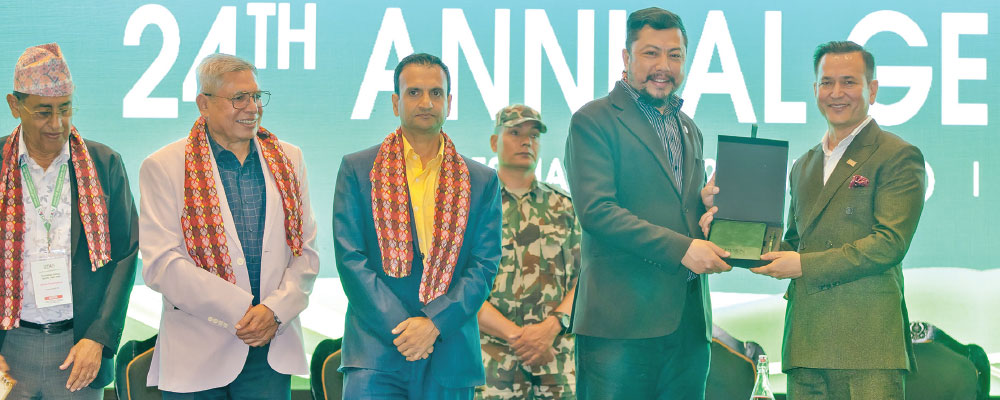
SATV, Kathmandu, Jun. 13 - Minister for Energy, Water Resources and Irrigation Biraj Bhakta Shrestha said that the government would take a strict approach against license holders who fail to move projects into construction.
“While the government is committed to being private sector-friendly, there is a need to be firm in matters of governance. Therefore, the government will take strict action against those who avoid construction under various pretexts,” he said while addressing the 24th annual general meeting of Independent Power Producers' Association Nepal (IPPAN) on Friday.
He said that the government is committed to transforming Nepal’s energy sector through policy reforms, private sector participation, expanded electricity trade, and major investment in transmission infrastructure.
"Public expectations for good governance and change remain high, and the government is working to meet those expectations through reforms and implementation-focused policies," he said.
He said the ministry has prepared an additional 32-point directive to support the implementation of the government’s 100-point governance reform agenda, aimed at making public services more dynamic and citizen-friendly.
“The country is currently at a starting point of energy sector transformation,” Shrestha said, adding that the government has already paved the way for private sector participation not only in power generation but also in electricity trade and transmission line development.
The minister said several laws and regulations that discourage investment are being amended.
He informed that the government is preparing to table the Water Resources Bill and the Renewable Energy and Energy Efficiency Bill during the current parliamentary session, while the Electricity Bill and Irrigation Development and Management Bill are expected in upcoming sessions.
Highlighting budget priorities, Shrestha said the government has positioned the energy sector as a key pillar of economic transformation and allocated sufficient resources to integrate electricity generation, trade, infrastructure and industrialisation.
He said that transmission lines and substations — considered the backbone of electricity supply — have been prioritised for the first time, with Rs. 70 billion allocated for their development.
The government has also set a target to complete more than a dozen strategically important transmission line projects within the next fiscal year.
He stressed the government’s focus on expanding cross-border electricity trade through priority transmission corridors, including Butwal–Gorakhpur, Inaruwa–Purnia, Dhalkebar–Muzaffarpur–Sitamarhi, Lamki–Dododhara–Bareilly, Lamahi–Lucknow, Nijgadh–Motihari and Chilime–Kerung.
Chairperson of the Infrastructure Development Committee under the House of Representatives, Ashish Gajurel, said that the government is ready with policy reforms for the development of the energy sector.
Stating that the government’s policies, programmes, and budget are private sector-friendly, he said future policies would become even more supportive of private investment.
He said that investment from the private sector is essential to fill the gap in investment for the development of the infrastructure sector.
Lawmaker Bharat Parajuli said the government is working to remove policy, legal, and administrative hurdles to achieve its target of generating 30,000 MW of electricity.
He added that low domestic consumption during the monsoon season and the lack of export markets for electricity have emerged as new challenges.
Acting Managing Director of the Nepal Electricity Authority, Dirghayu Kumar Shrestha, said he is positive about allowing private sector participation in electricity trading and transmission line construction.
He added that managing the growing volume of electricity production is becoming increasingly challenging.
“The government’s policies, programmes, and budget for the energy sector are commendable. It has proposed allowing private sector participation in electricity trading and transmission lines. In addition, the budget aims to address several existing problems, making it a positive step,” said President of the Nepal Chamber of Commerce, Kamlesh Kumar Agrawal.
He said Nepal has long been trapped in the “quagmire of policy and destiny.”
“Policies have always been good, but implementation has not been effective,” he said. “As a result, despite good policies, expected outcomes have not been achieved.”
President of the Confederation of Nepalese Industries, Birendra Raj Pandey, stressed the need for productive industries to increase electricity consumption.
Pandey also welcomed the plan to open electricity trading and transmission line construction to the private sector.
Former President of the Independent Power Producers' Association, Nepal, Krishna Prasad Acharya, called for the immediate implementation of a one-door system and urged the government to ease barriers hindering the energy sector.
IPPAN President Ganesh Karki expressed confidence that the budget and policy and programme have addressed the concerns of the private sector and will be effectively implemented.
“We have been continuously raising these issues for the past two to three years, and the commitments included in Rastriya Swatantra Party's manifesto have now been incorporated into the policy and programme as well as the budget. Therefore, we are hopeful that work will now move forward,” Karki said.
“The government has mentioned implementing PPAs under the take-or-pay model. We hope that will be carried out. It has also stated that PPAs will be signed within 180 days. Even 100 days have not passed yet, so we remain hopeful that this commitment will also be fulfilled.”
Stating that they have long been urging for an extension of the required commercial operation date (RCOD) deadline, he said, despite repeated discussions at the board level, the deadline has not been extended.
Karki said the government should expedite the issuance of the sunset law, even though an ordinance, to accelerate the pace of development in the sector, stating that the energy sector faces numerous challenges