




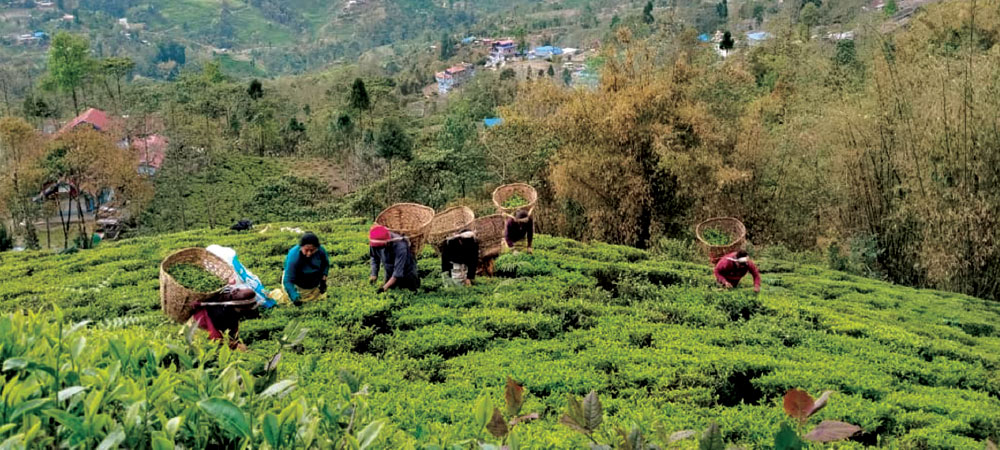
SATV, Kathmandu, July. 17 - Nepali tea, one of the country's major export commodities, has consistently remained in the limelight.
Sometimes there is a high level of exports, sometimes there are obstacles to exports, and sometimes issues of quality have brought Nepali tea into the limelight.
For thousands of smallholder farmers, however, tea has become the primary source of household income.
Tea cultivation in Nepal began in 1920 BS, and the industry has now completed 163 years. Over the decades, Nepali tea has earned a distinct identity in the international market, according to tea entrepreneurs.
Tea traders said that Nepali tea is in good demand in the global tea market because Nepali tea is of higher quality and has a different taste from other countries.
However, tea experts complain that the government has not provided the necessary support for the investment made by farmers and the private sector in Nepali tea.
The lack of an internationally accredited laboratory in Nepal, the government's failure to establish government-to-government (G2G) trade agreements with importing countries, and insufficient support for tea production, expansion and exports have caused major losses not only to farmers but also to the nation, said Uday Chapagain, proprietor of Gorkha Tea Estate in Sundarpani, Ilam.
"We have struggled for years after taking bank loans to produce organic tea. We have stopped keeping records of the investment made in producing compost manure, maintaining tea gardens and supporting farmers. Yet the state has still failed to recognise tea as a valuable commodity," Chapagain said.
He added that while climate change has become a global challenge, no study has been conducted on the environmental contribution of tea plantations covering the eastern hills.
"Tea plantations play a significant role in maintaining environmental balance, but the government has not even considered taking initiatives for the sustainable conservation of Nepali tea," he said.
Chapagain, who has been involved in tea farming for nearly 30 years, has also been supporting farmers supplying green tea leaves to his estate by helping them adopt organic practices.
His assistance includes support for cattle rearing, biogas plants and hand tools. "The growing international reputation of Nepali tea is largely because it is organic. Fully organic production is the only sustainable future for Nepali tea," he said.
According to Chapagain, tea entrepreneurs and farmers have repeatedly urged the government to invest in the tea sector, establish testing laboratories and create an auction market, but their demands have yet to produce concrete results.
Meanwhile, Nepal's tea industry suffered a major setback after the Tea Board of India tightened regulations on tea imports from Nepal since May 1.
Many Nepali tea factories remained closed for an extended period, and hundreds of thousands of kilograms of green tea leaves worth millions of rupees were wasted. Although the Tea Board of India resumed its previously suspended tea testing system through a notice issued on June 29, exporters said the restrictions on Nepali tea have not been significantly eased.
Uttam Kumar Shrestha, proprietor of Taragaun Tea Estate in Ilam, said Nepali farmers and tea entrepreneurs must take India's indirect restrictions seriously.
"We now need to focus on producing fully organic tea and targeting third-country markets as an alternative to India. Farmers and industries must be committed to this goal," he said.
He said that there could be no compromise on quality, warning that the future of Nepali tea depends entirely on maintaining high standards.
Tea entrepreneurs also acknowledge that both farmers and factories share responsibility for some of the industry's problems.
Gyani Limbu, vice-chairperson of the Suryodaya Tea Producers' Association, said problems have increased because green tea leaves are being taken across the border to India, while some CTC and other factories purchase even low-quality tea leaves at attractive prices.
"When local factories enforce strict quality standards but Indian factories offer higher prices and buy almost any type of green leaf, farmers naturally become tempted," Limbu said.
Former Constituent Assembly member and tea farmer Tikaram Lepcha also said local, provincial and federal governments should introduce stricter policies for the tea sector.
"Some farmers are still secretly using chemical fertilisers and pesticides in pursuit of higher yields.
Strong laws are needed to discourage such practices," he said. Meanwhile, farmers who have long exported certified organic tea to third-country markets said that although organic certification is expensive, it provides confidence in marketing their products.
Rabin Rai, General Secretary of the Central Tea Cooperative Federation, said annual certification and renewal costs amount to around Rs. 700,000 to Rs. 800,000.
"Individual farmers cannot afford organic certification on their own. Tea industries usually certify the farmers associated with them.
That is why third-country markets remain the most reliable destination for Nepali tea," he said. According to tea entrepreneurs, fully certified organic Nepali tea continues to get strong demand in Germany, Russia, France, Belgium, the Netherlands, China and many other countries.