




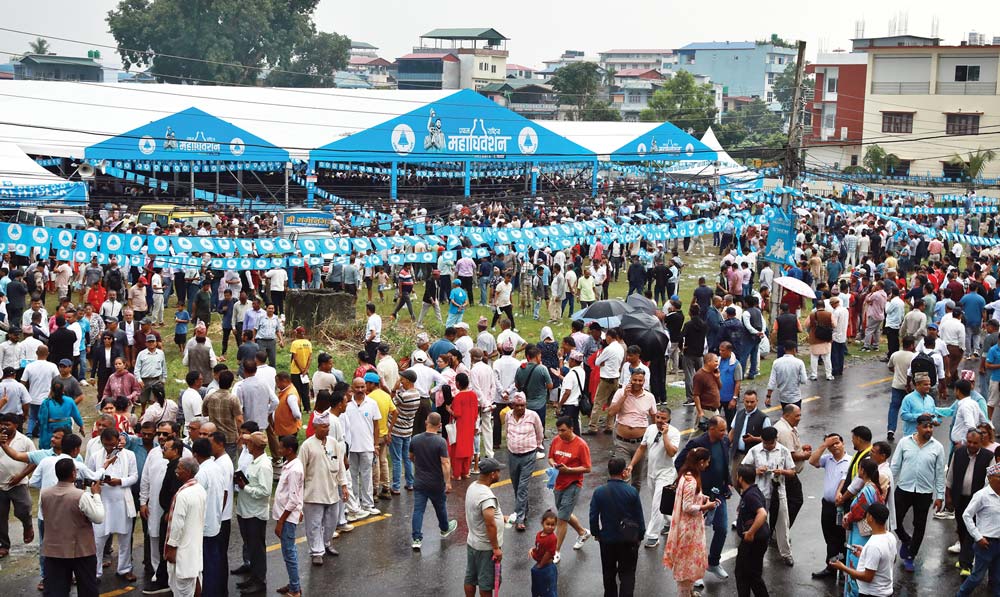
SATV, Kathmandu, Jun. 22 - The 1st General Convention of the ruling Rastriya Swatantra Party (RSP) began in Bharatpur, Chitwan, on Sunday. Delegates, well-wishers and supporters arriving from across the country view the convention not merely as an internal organisational process but also as an opportunity to shape the country’s political direction.
Good governance, nationalism, employment, agriculture and a production-oriented economy have emerged as the key expectations among participants.
Shivaram Rijal, 75, of Chaukitol, Hetauda Sub-Metropolitan City-1, said the compulsion forcing young people to opt foreign employment must end. According to him, political change will only be meaningful if opportunities are created within the country.
“I believe this convention will amplify the voices of the youth, establish good governance and present a clear roadmap for nation-building.” He stressed that political parties should rise above factional interests and work towards common goals. People seek a system of governance that is transparent, accountable and result-oriented, he added.
Similarly, Pareshwar Kandel, 74, from Bihu, Kathekhola Rural Municipality-6 in Baglung, is attending the convention as a delegate. He said the party should adopt a clearer and stronger position on issues of national interest.
“No one stands above nationalism. There can be no compromise on matters concerning national interests,” he said. The party should now introduce concrete programmes in favour of ordinary villagers, farmers, labourers and the productive sector. Kandel said agriculture remains the backbone of Nepal’s economy, but long-term neglect by the state has left farmers discouraged.
“If the problems faced by farmers are understood and agriculture is modernised and commercialised, the country’s economic foundation can be strengthened,” he said. “Our generation endured many hardships, and we hope future generations will not have to suffer in the same way.”
Shubhadra Parajuli Adhikari, who came from Gaindakot in Nawalparasi to observe the convention, highlighted party unity and collective leadership as important issues. Debate and discussion are natural within democratic parties, but they should lead to consensus rather than division, she added. “Only if the party moves forward in unity can the campaign for national development succeed,” she said. She argued that leadership should balance the energy of the younger generation with the guidance of experienced members.
“The thinking of Gen Z and the experience of older generations should go hand in hand,” she said. “Collective leadership, rather than factionalism, strengthens the organisation and also has a positive impact on governance.”
Sangeet Das, 26, party chairman of the Ward No. 3 of Gauriganj Rural Municipality in Jhapa and a convention delegate, said increasing production is the foundation of national prosperity. According to him, economic transformation is impossible without prioritising agriculture, industry and entrepreneurship.
“The country cannot move forward without placing production at the centre,” he said. He argued that farmers should have guaranteed access to markets for their produce and that the government should provide purchase guarantees if necessary.
“Even today, farmers face difficulties in finding markets for their products,” he said. “Policies are needed to increase production, ensure markets and accelerate economic progress.
These are also the expectations behind the support people have given the party.”
Mohammad Ali Miya, 70, of Bharatpur Metropolitan City-1, said ending corruption is the country’s foremost necessity. The public expects good governance and that must begin with controlling corruption, he said.
“Those involved in corruption should face immediate legal action,” he said. “A culture should be developed that discourages inefficiency while honouring honest and result-oriented individuals.”
Most participants expect the convention to focus on leadership and policies capable of addressing the everyday concerns of citizens, rising above partisan politics. Thus, the convention in Bharatpur has become not only a process of selecting organisational leadership but also a political test of how effectively public expectations can be addressed.
Gorkhapatra distributed at venue
Copies of the Gorkhapatra daily were distributed free of charge to participants at the convention venue, where many were seen reading the newspaper. Farmers were also present with stalls selling various locally produced goods.