


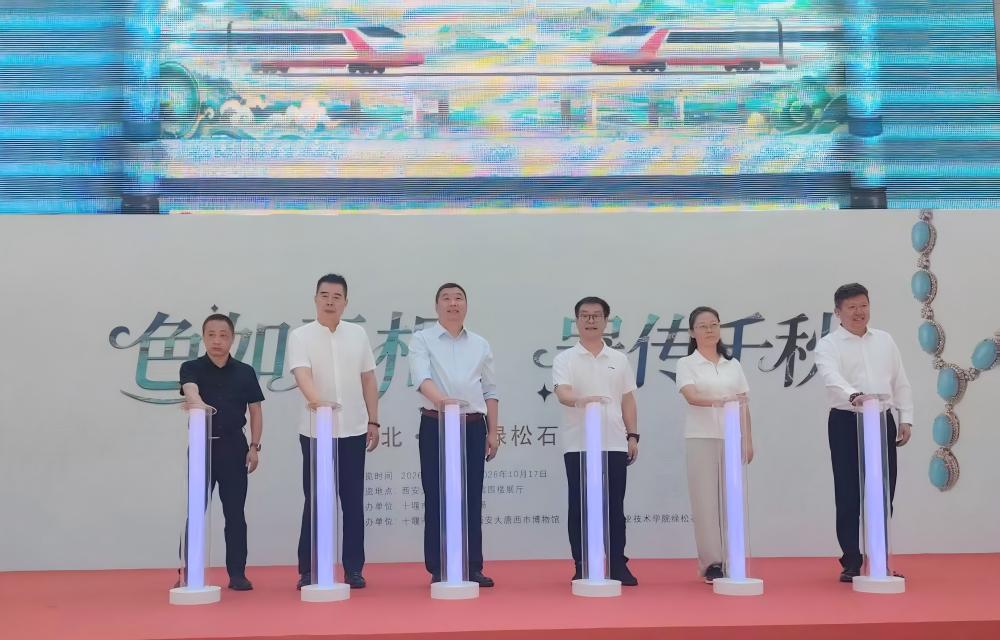
The "Color Resembling Heaven, Craft Enduring Millennia – Hubei · Shiyan Turquoise Culture Exhibition" officially opened to the public at the Datang West Market Museum in Xi'an. Pictured: The unveiling ceremony at the opening event. (Photo by Zhao Yimeng)
SATV, July 17 – On July 17, the "Color Resembling Heaven, Craft Enduring Millennia – Hubei · Shiyan Turquoise Culture Exhibition" officially opened to the public at the Datang West Market Museum in Xi'an. The exhibition is hosted by the Culture and Tourism Bureau of Shiyan City, Hubei Province, and co-organized by the Shiyan Museum, the Datang West Market Museum in Xi'an, and the Turquoise Industry College of Hubei Industrial Polytechnic.
"This touch of 'sky-blue' from the deep mountains of Shiyan, crossing the Qinling Mountains, carries millennia of profound heritage and continues the deep bond between our two regions," said Dong Wenqiang, Vice President of Datang West Market Group and Director of the Datang West Market Museum, in his opening address. He noted that this cultural event spanning the Qinling Mountains, leveraging the transportation advantage of the Xi'an–Shiyan High-Speed Railway's "one-hour living circle," uses turquoise as a link to build an important platform for cultural tourism exchange and mutual learning between Qin and Chu.
Ling Jixian, Deputy Party Secretary and Deputy Director of the Culture and Tourism Bureau of Shiyan City, stated that Qin and Chu are connected by mountains and rivers, with a long and shared cultural lineage. In ancient times, Shiyan turquoise was already a treasure of Chinese civilization, and Shiyan remains a core production area, carrying a millennia-old heritage from prehistoric beliefs to imperial tributes. Shiyan turquoise was transported along the Hanjiang Ancient Road to Chang'an and integrated into the Silk Road, planting the seeds of intertwined civilization between the two regions. He added that the full opening of the Xi'an–Shiyan High-Speed Railway has further shortened the temporal and spatial distance between the two cities. This exhibition is not only a vivid practice of cultural tourism collaboration between Xi'an and Shiyan, but also a comprehensive showcase of the natural beauty, exquisite craftsmanship, and millennia-old heritage of Shiyan turquoise, offering the ancient capital's residents a unique verdant-green cultural experience.
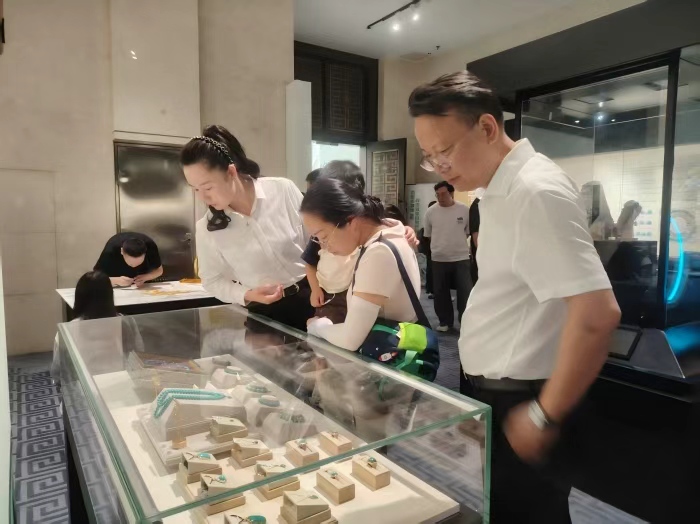
Citizens visiting the exhibition. (Photo by Zhao Yimeng)
At the unveiling ceremony, as the light on the launch platform illuminated, the background screen showed images of the Xi'an–Shiyan high-speed train racing through mountains and valleys. This newly opened transport artery is bringing the stories of turquoise from the depths of the Qinba Mountains to the starting point of the Silk Road—the unveiling marked not only the exhibition but also the official implementation of Xi'an–Shiyan cultural tourism cooperation. Following the opening ceremony, the directors of the two museums exchanged cultural and creative products, and products from the Shiyan Museum were simultaneously introduced for display and sale at the Datang West Market Museum's cultural creative shop, deepening the cultural dialogue between Shiyan and Xi'an into everyday life.
Inside the exhibition hall, multiple fine turquoise pieces were on display, vividly demonstrating hundreds of millions of years of geological formation and master craftsmen's ingenuity. Many local residents and tourists stopped to admire and immerse themselves in the cultural charm of Qin–Chu symbiosis.
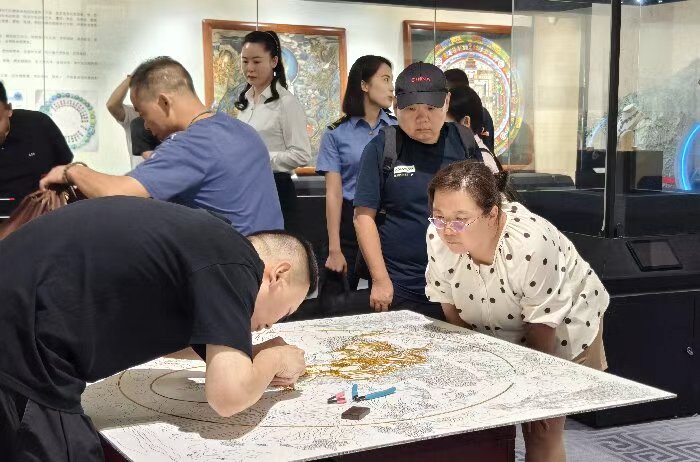
Staff from Shiyan crafting turquoise art pieces on-site. (Photo by Zhao Yimeng)
According to the organizers, Shiyan possesses over 50% of the world's turquoise reserves and produces more than 70% of China's high-quality raw ore, ranking among the top in the country. With its unique appearance of "color like heaven, texture like porcelain," Shiyan turquoise has become a benchmark and model in the industry. From the ancient legend of Nüwa mending the heavens with five-colored stones, to the material source tracing of the turquoise dragon-shaped artifact from the Erlitou site; from the precious records of the suspected He Shi Bi jade disc, to the crown ornaments on the Qinghai-Tibet Plateau, Shiyan turquoise has always been embedded in the pluralistic yet unified fabric of Chinese civilization, witnessing the millennia-long history of north–south integration and east–west exchange.
It is understood that the turquoise ornaments and craftsmanship brought by Princess Wencheng when she entered Tibet had a profound impact on the region. Turquoise was used in the crown of King Songtsen Gampo, to adorn the Jokhang Temple's statue of Buddha, and as ceremonial offerings. The application of turquoise in Tibet gradually expanded, with gold and turquoise becoming the primary adornments. In Tibetan Buddhism, turquoise is endowed with spiritual significance, with over 80% of ritual implements inlaid with turquoise. For the Tibetan people, turquoise is not merely an ornament, but a faith, a culture, and a reverent respect—a symbol of sanctity and hope.
This exhibition is the first special inter-museum exchange since the opening of the Xi'an–Shiyan High-Speed Railway. Divided into four units, it features over 100 collections including raw ore specimens, antique-style ritual vessels, intangible-heritage carved pieces, and filigree inlay works, weaving together four thematic threads: geological science, cultural relic tracing, craftsmanship appreciation, and practical collection and appreciation.
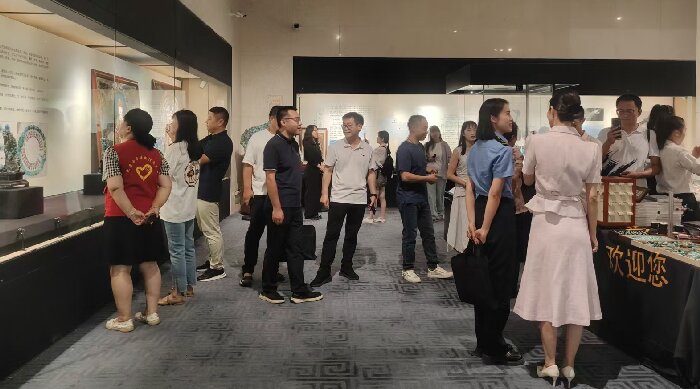
A view of the exhibition hall. (Photo by Zhao Yimeng)
The exhibition hall also features a turquoise DIY experience area and a scientific identification counter, allowing visitors not only to view the exhibits but also to personally experience the process from raw stone to finished jewelry, or to learn identification skills through hands-on comparison of physical samples. The exhibition will run until October 17, 2026, and the fourth-floor exhibition hall of the Datang West Market Museum will resonate with the pulse of civilization echoing within turquoise, offering a touch of the Chinese spirit behind that verdant green.