




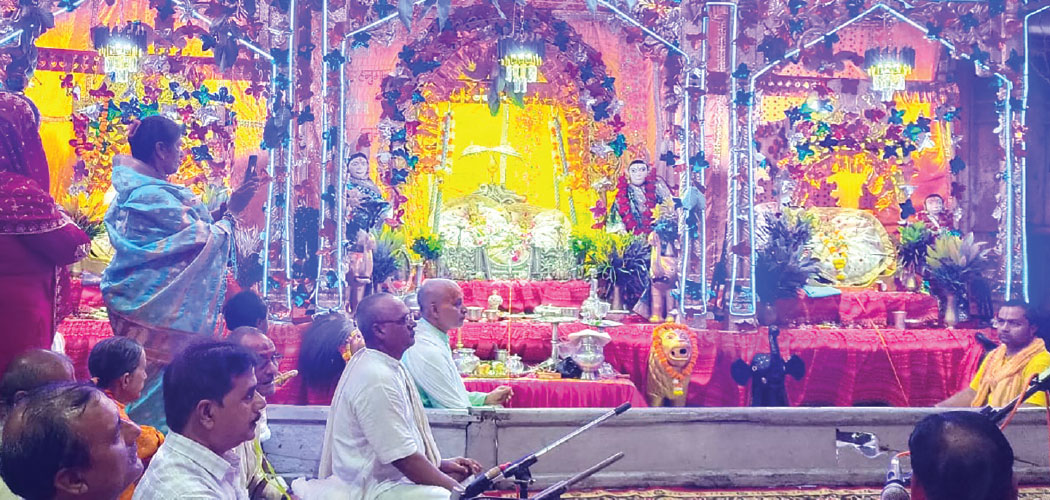
SATV, Kathmandu, Aug. 21 - As the evening falls, the songs of the Kajri, Malhar and Jhula echo from the temples of Janakpurdham.
In some places, the idol of Sitaram placed on a swing is being worshipped, while in others, women sit in groups and sing folk songs of the rainy season.
This scene of religious faith, folk culture, and collective entertainment has created a festive atmosphere in Janakpurdham.
The Jhulan Utsav, celebrated from the last Saturday of Saun Shukla Tritiya to the full moon, is not only a religious festival in the Mithila region but also a cultural festival connected to folk life.
The Kajari, sung during the Jhulan festival, describes the rainy season, separation, love, and Radha Krishna. Although its content has expanded over time, cultural scholars said that its core aspects remain the praise of the gods and goddesses and devotion.
Songs of Pawas, Malhar, Barahmasa and Jhula also make the festival livelier. According to Ramroshan Das Vaishnav, the successor of the Mahant of Janaki Temple, the Jhulan Utsav unites everyone in a single religious and cultural spirit.
He said that the tradition of swinging the idol of Sita Ram for about 15 days in Janakpurdham has been going on for a long time. “The Jhulan Utsav is an important occasion for devotion, joy and social interaction,” he said.
However, cultural experts are concerned that the original charm of the swing festival is weakening compared to the past. Although women used to participate significantly in folk singing and hymns that lasted until late at night, it is said that such participation is now decreasing.
During the Jhulan Utsav, pilgrims from the bordering Indian regions flock to Janakpurdham.
Cultural experts say that the true spirit of the Jhulan Utsav will reach future generations only if the old collective participation and originality associated with the song can be preserved.
According to religious scholars, the Jhulan Utsav festival in Janakpurdham is believed to have been started by the saint Surkishore Das of the Ramanandi sect.