




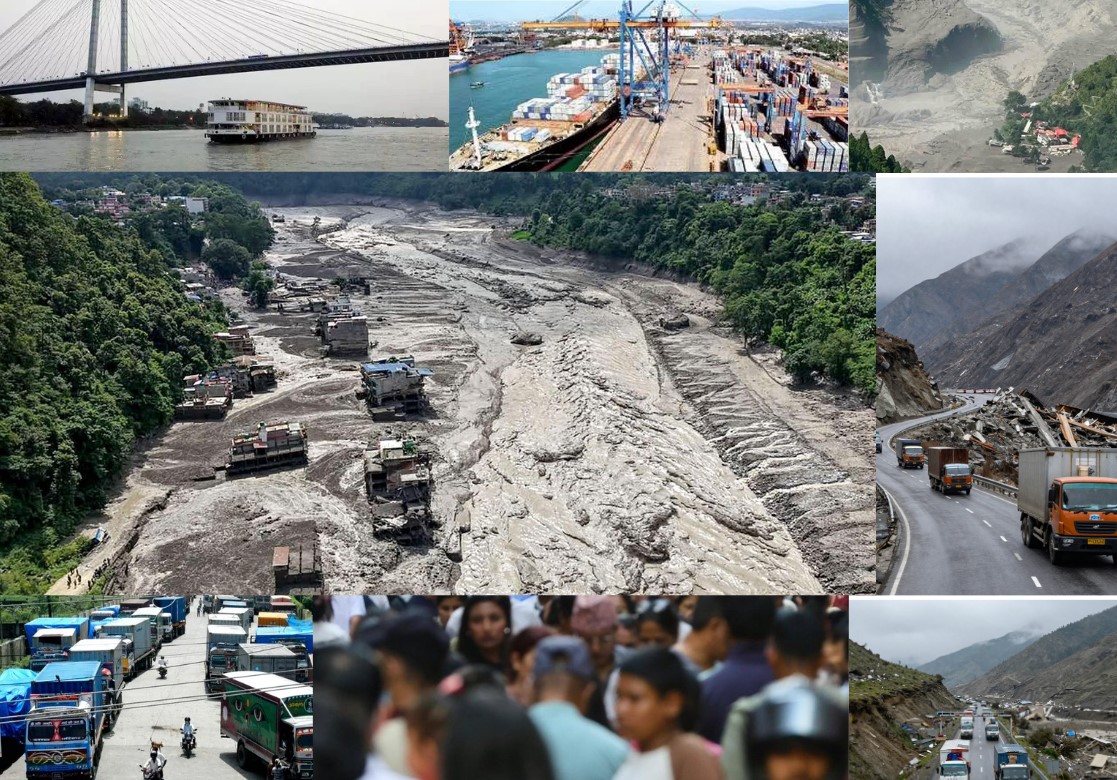
SATV Kathmandu, Oct, 1- Nepal’s disrupted supply chain is gradually returning to normal as major highways reopen following floods, landslides and days of heavy rainfall. Supplies of essential goods arriving from India have started to improve, with pressure on cooking gas easing and government agencies reporting adequate stocks of sugar.
But just as the supply chain begins to recover, another major problem is emerging: Nepal’s key trade routes with China remain disrupted.
The August 26 Bhote Koshi flood caused extensive damage in the Rasuwagadhi area, severely affecting one of Nepal’s major trade routes with China. The Tatopani border also remains closed, while imports through the Korala border have been disrupted after roads along the Kaligandaki Corridor were blocked.
The disruption is beginning to raise the cost of goods imported from China, traders say. Goods that would normally be transported directly from China into Nepal are now being routed through Indian seaports, increasing transportation distances, delivery times and container costs.
In other words, while Nepal’s supply chain with India is gradually recovering, the supply chain with China remains under pressure. With Dashain, Nepal’s peak consumption season, approaching, the concern is no longer simply whether goods will be available in the market, but also how much consumers will have to pay for them.
Roads Reopen, Easing Supplies from India
As rainfall has subsided in recent days, major roads connecting Kathmandu with other parts of the country have gradually reopened.
According to Shubhanjan Dahal, information officer at the Department of Roads, the BP Highway, Prithvi Highway, Kanti Highway, Tribhuvan Highway, Araniko Highway and the Balkhu–Kulekhani–Bhimfedi–Hetauda road had resumed operation by the morning of October 1.
Traffic has resumed after landslides were cleared at several locations. Although some sections are operating one-way, most stretches are now open to two-way traffic.
The Department of Roads says the situation could become significantly easier by Dashain if there are no further major floods, landslides or heavy rainfall.
The reopening of these roads has already begun to ease the transportation of goods arriving from India.
Pressure on Cooking Gas Eases
The reopening of highways has also brought relief to one of the most closely watched areas of the supply chain: cooking gas.
Diwan Chand, president of the Nepal LPG Industry Association, said gas supplies in the southern plains, including Mahottari, Dhanusha and Nepalgunj, have already returned to normal.
Gas stocks have also started accumulating in industrial storage tanks, he said, indicating that supplies are no longer being exhausted immediately after arriving.
Kathmandu Valley, however, still depends on several days of transportation cycles.
According to Chand, priority is being given to sending LPG from Barauni in India to Kathmandu. In recent days, 30, 35 and even 40 LPG bullets have reportedly been dispatched to Kathmandu in a single day.
As trucks that had been stranded along the routes gradually reach Kathmandu, consumers could begin to feel a significant improvement in supply within three to four days, Chand said.
Kathmandu’s regular LPG demand stands at around 45,000 to 50,000 metric tonnes a month, according to the association. If road conditions remain stable, the supply could return fully to normal within a week.
Nepal Oil Corporation spokesperson Manoj Kumar Thakur also said the main problem with LPG supply was linked to road connectivity. Other petroleum products were less affected because they are transported to Amlekhgunj through a pipeline.
Government Says There Is No Sugar Shortage
While consumers have complained about the shortage and rising price of sugar in the market, Salt Trading Corporation says it has adequate stocks.
According to the corporation’s information officer, Mohan Thapa, sufficient sugar is available. Sugar is being sold to consumers through festival-targeted outlets at Rs105 per kilogram, while traders are also being supplied according to demand. Processed sugar is priced at Rs109 per kilogram, he said.
Salt Trading has already imported 12,500 metric tonnes of sugar and is in the process of bringing in additional supplies.
Although transportation has been affected by road blockages, efforts are being made to bring sugar through alternative routes, Thapa said.
Fresh vegetables, however, remain more vulnerable because they spoil quickly. Even a short disruption in transportation can affect their quality, availability and prices.
Supply Eases from India, but China Route Remains Blocked
This has created a major contradiction in Nepal’s supply chain.
As roads linking Nepal with India reopen, supplies from the southern border are gradually improving. But major routes used to import goods from China remain closed.
Rasuwagadhi is one of Nepal’s most important trade points with China. The August 26 flood caused significant damage to roads and infrastructure around the border, disrupting regular trade.
Tatopani also remains closed. Imports through Korala have been affected because roads along the Kaligandaki Corridor remain blocked.
The disruption has forced traders importing Chinese goods to look for alternatives.
Some businesses have started bringing Chinese goods through Indian ports such as Kolkata and Visakhapatnam before transporting them overland into Nepal.
But while this keeps trade moving, it also increases costs.
From a 127-Km Route to a 1,439-Km Detour
For Nepal-China trade, distance directly translates into cost. According to traders, the distance from Tatopani to Kathmandu is around 113 km, while the distance from Rasuwagadhi to Kathmandu is about 127 km. The route from Korala to Kathmandu is approximately 470 km.
But when the same goods are routed through India, the distance increases dramatically. The distance from Kolkata port to the Birgunj border point is around 706 km, while the route from Visakhapatnam can extend to approximately 1,439 km.
Some traders are increasingly using Visakhapatnam because it can accommodate larger vessels and is considered less congested. But the additional distance between the Indian seaport and Nepal ultimately increases transportation costs.
Traders say Chinese goods routed through India could now cost at least 15 percent more, or even higher, depending on the product and transportation conditions.
This means that goods that once travelled just over 100 km from the northern border to Kathmandu may now have to travel more than 1,400 km before reaching the Nepali market.
What Nepal Imports from China ?
China is one of Nepal’s major trading partners, and the range of goods imported from China is extensive.
Nepal imports ready-made garments, shoes, electronics, communication equipment, computers, smartwatches, headphones and other gadgets, as well as electric vehicles.
China also supplies Nepal with apples, pears, garlic, onions, ginger, chocolates, dry fruits, toys, stationery and other consumer goods.
Demand for clothes, footwear, electronics, toys, gadgets and other consumer products rises sharply during Dashain. A prolonged disruption in the China trade routes could therefore have a visible impact on the market during the festival season.
More Than Rs425 Billion Imported from China Last Fiscal Year
The scale of Nepal’s trade with China highlights the importance of keeping the northern trade routes operational.
According to the available trade data, Nepal imported goods worth Rs76.401 billion from China during the first two months of fiscal year 2083/84. During the same period, Nepal’s exports to China stood at only Rs293.3 million.
In fiscal year 2082/83, Nepal imported goods worth Rs425.247 billion from China.
These figures show that disruption of China-bound trade routes is not merely a problem for individual traders or particular products. It has implications for the broader supply chain.
A prolonged disruption could affect the transportation of industrial raw materials, electronics, electric vehicle components, garments, footwear, gadgets and other imported goods.
Container Costs Add to the Pressure
The closure of Chinese border routes is not the only factor pushing up costs.
Traders say international shipping conditions have also become difficult. According to them, the Iran-US conflict has left a large number of containers stranded in the Middle East, creating a shortage of available containers.
Traders claim that containers that previously cost around US$2,000 are now costing between US$4,500 and US$5,000.
If this situation continues, goods imported from China through India will face a double cost burden: longer transportation distances and higher international container costs.
Ultimately, the additional cost could be passed on from importers to consumers through higher market prices.
Why Rasuwagadhi Matters ?
According to the Himalayan Cross-Border Trade Association, Rasuwagadhi is among the most practical routes for importing goods from China into Nepal. The association has called for intensified diplomatic efforts to reopen the route as soon as possible.
Traders say Nepal can continue importing goods through India, but doing so changes the country’s overall trade cost structure.
Routing large volumes of Chinese imports thousands of kilometres through India is not considered a sustainable long-term solution by traders.
They argue that reconstruction of damaged roads must go hand in hand with immediate diplomatic coordination between Nepal and China to restore cross-border trade.
Two Different Supply Chain Pictures Ahead of Dashain
Nepal’s supply market is currently showing two contrasting pictures.
On one side, supplies of gas, food and other essential goods from India are improving as highways reopen. Major roads connecting Kathmandu have resumed operation, LPG trucks are arriving in the capital, and gas supplies in the southern plains have returned to normal. Salt Trading says sugar stocks are adequate.
On the other side, key border points used for imports from China remain closed. Traders are therefore turning to Indian ports to bring Chinese goods into Nepal, increasing both transportation distances and costs.
This distinction becomes particularly important as Dashain approaches.
Dashain is not only Nepal’s biggest cultural festival; it is also the country’s peak consumption season. Demand for clothes, shoes, electronics, mobile phones, gadgets, toys, food and fruits rises significantly during the period.
If supply costs increase at the same time, consumers could eventually bear the additional burden through higher retail prices.
The Question Is No Longer Just Whether the Roads Are Open
The central question now is no longer simply whether the roads have reopened.
The more important question is: How are goods reaching the market after the roads reopen, and how much has the cost of doing so increased?
The availability of goods and the cost of making those goods available are two different things.
Chinese goods may continue to reach Nepal through India, preventing an immediate shortage. But if they have to travel a much longer route, the structure of the supply chain has changed even if the goods remain available in the market.
This means the government needs to monitor not only the availability of goods during the Dashain season, but also transportation costs, import costs, wholesale prices and retail prices.
The current situation therefore presents Nepal with a clear supply-chain challenge: the roads are reopening, but one of the country’s most important trade routes remains closed.
For consumers, the question ahead of Dashain may ultimately be not only whether the goods will be available, but at what price they will arrive.