




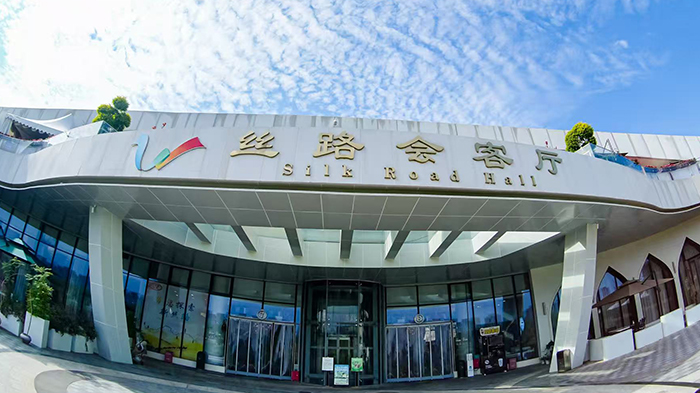
The Silk Road Meeting Room at Xi'an Central Asia Park is a landmark project implementing the important outcomes of the China–Central Asia Xi'an Summit. It is a new economic, trade, and cultural exchange platform integrating landscape gardens, specialty dining, and cultural exhibitions and sales.
SATV, Xi'an, September 4 (Huang Xiaoou, Zhao Yimeng) — On September 3, the Xi'an business delegation of South Asia Network Television Media Group (Nepal) was invited to visit and inspect the Silk Road Meeting Room at the Xi'an Central Asia Park. The two sides held in-depth discussions on "Central Asia + South Asia" cultural connectivity, international communication, economic and trade liaison, cultural tourism and study tours, and cross-border project cooperation.
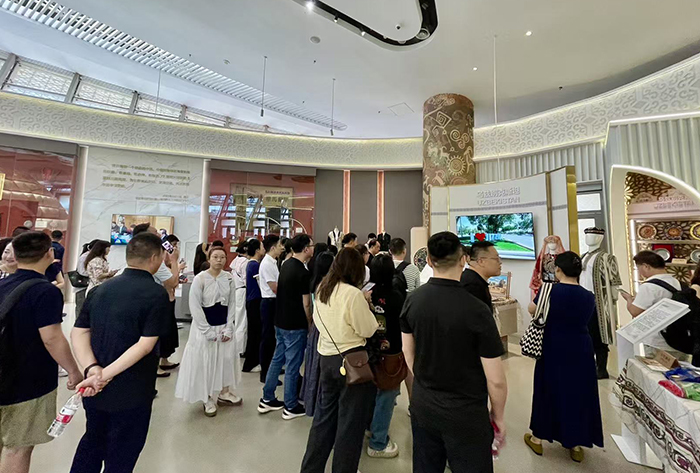
A steady stream of visitors tours the Silk Road Meeting Room at Xi'an Central Asia Park.
As an important tangible outcome of the first China–Central Asia Summit, the Silk Road Meeting Room at Xi'an Central Asia Park has become a significant window for people-to-people connectivity between China and the five Central Asian countries, as well as a key bridge for deepening bilateral economic and trade exchanges and civilizational dialogue. It is positioned as a major platform for business negotiations, cultural exchanges, tourism promotion, and commodity exhibitions between China and the five Central Asian nations. It serves not only as a "Silk Road Kaleidoscope" showcasing Central Asian culture, but also as a physical hub fostering people-to-people bonds and economic cooperation.
Fang Xun, General Manager of the Silk Road Meeting Room at Xi'an Central Asia Park, shared during the exchange that the Meeting Room is currently dedicated to two-way cross-border trade and cultural exchange: on one hand, actively promoting high-quality domestic products to West Asian, Central Asian, and other countries; on the other hand, introducing distinctive foreign handicrafts and food products into the Chinese market. He particularly mentioned that he had previously visited Nepal and was deeply impressed by its local products. Noting that while the exhibition hall currently covers products from multiple Central Asian countries, Nepalese products are absent, Fang Xun expressed a clear expectation: "We hope to carry out in-depth cooperation with South Asia Network TV (SATV) in the future, to achieve two-way exchanges and connectivity between China and Nepal in culture, handicrafts, food, and other fields."
Zhao Wenhua, the Xi'an business representative of South Asia Network Television Media Group (Nepal), highly recognized the platform value, business layout, and opening-up achievements of the Silk Road Meeting Room. He introduced that SATV, as an international media platform deeply rooted in South Asia and reaching seven countries, possesses mature overseas communication channels, trade liaison resources, and cultural exchange experience, and has long been committed to telling China's story well, spreading the voice of the Silk Road, and empowering economic, trade, cultural, and tourism cooperation between China and foreign countries.
During the discussion, the two sides conducted in-depth consultations on key areas including international media collaboration, joint Silk Road cultural exhibitions, cross-border product promotion, China-foreign cultural tourism study tours, international educational exchanges, and two-way resource matching, reaching a preliminary strategic cooperation consensus. Both sides agreed that Central Asia and South Asia are both core regions along the "Belt and Road," with geographical proximity, cultural affinity, and enormous cooperation potential. In the future, they will leverage their respective platform advantages to regularly carry out two-way exchanges, resource sharing, and joint project development.
Fang Xun further stated that the Silk Road Meeting Room, based in Xi'an and deeply rooted in Central Asia, has already accumulated mature platform resources and practical experience in foreign affairs receptions, government-enterprise liaison, industry-education integration, cultural tourism study tours, and trade exhibitions. In the future, the aim is to break geographical boundaries, coordinate with SATV's quality resources, and build a new channel for two-way exchange between Central Asia and South Asia through media communication, cultural connectivity, and trade coordination.
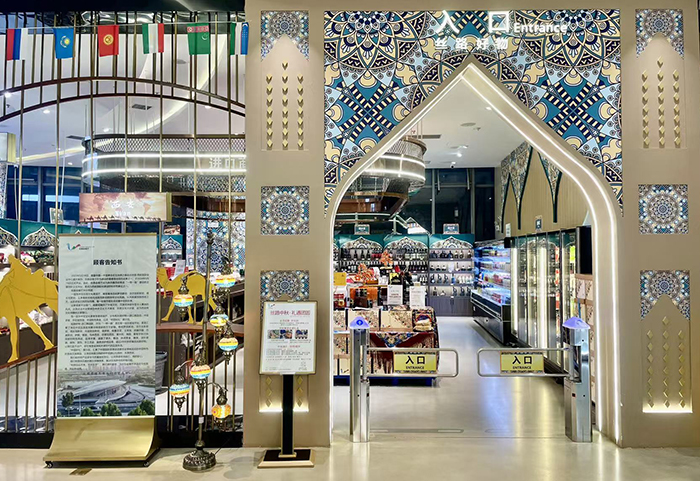
The Silk Road Meeting Room brings together nearly 2,000 types of specialty products from the five Central Asian countries—Kazakhstan, Kyrgyzstan, Uzbekistan, and others—as well as more than 20 countries including Russia and Turkey, covering grains, snacks, handicrafts, and other "Silk Road treasures."
It is understood that the Meeting Room has a clear functional zoning and rich, diversified business formats, with two floors of exhibition and experience space. The first floor serves as the core area for achievement displays and cultural exchange, featuring a Shaanxi Sister Cities exchange achievements exhibition area and a cultural exhibition area for the five Central Asian countries. These centrally showcase the unique cultural characteristics and humanistic landscapes of the five Central Asian nations, as well as the fruitful outcomes of long-term economic, trade, and cooperative endeavors between China and these countries, comprehensively presenting the depth of exchange and cooperation among Silk Road nations. Meanwhile, the venue brings together nearly 2,000 types of specialty products from the five Central Asian countries—including Kazakhstan, Kyrgyzstan, and Uzbekistan—as well as more than 20 countries such as Russia and Turkey, covering grains and oils, snacks, handicrafts, and other "Silk Road treasures."
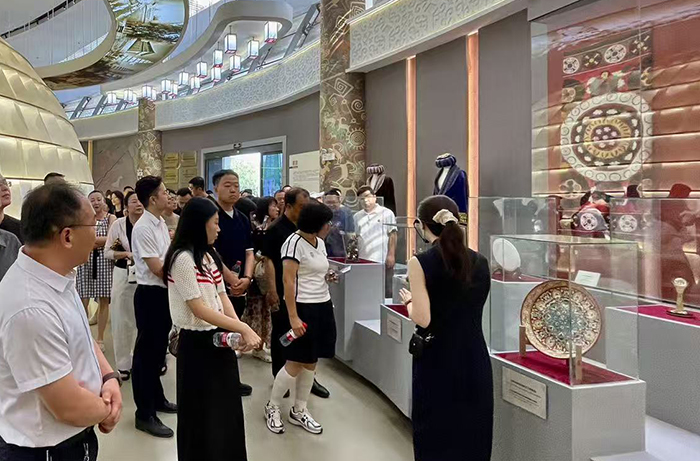
The cultural exhibition area for the five Central Asian countries at the Silk Road Meeting Room, Xi'an Central Asia Park.
As the starting point of the ancient Silk Road, Xi'an serves as the core hub connecting Central Asia and South Asia. This visit and exchange has established a brand-new cooperation link between the "Central Asia Platform" and "South Asia Media." Both sides will continue to deepen engagement, refine cooperation plans, use culture as a bridge and trade as a lifeline, link the east-west two-way channels of the Silk Road, and compose a new chapter of civilizational mutual learning and win-win cooperation along the Silk Road in the new era.