




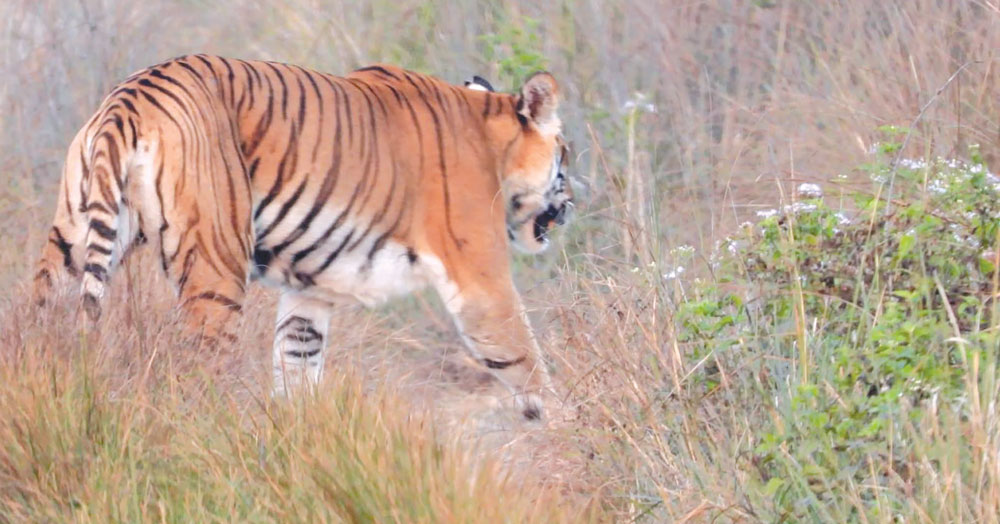
The buffer-zone community forests in Nawalpur, which are well known for their one-horned rhinos, have increasingly become popular among tourists seeking to spot Bengal tigers.
The number of domestic and foreign tourists visiting these forests on jeep safaris has also been increasing after tigers started being spotted during the excursions, said Nar Bahadur Mahato, chairperson of the Gundrahi Dhakaha Community Forest.
Bengal tigers are frequently spotted during jeep safaris in Namuna, Gundrahi Dhakaha, Shantikunj and Krishnasar community forests in Kawasoti, as well as Divya Buffer Zone Community Forest in Devchuli. These forests lie in the buffer zone of Chitwan National Park.
The Narayani River divides the western section of the national park, stretching from Kasara to Triveni, into two parts. Mahato said tourist interest in the area had grown after tigers began appearing during jeep safaris in the buffer-zone community forests on this side of the river.
According to him, tigers from the park's core area across the river are increasingly visiting these forests because prey animals are readily available there. “Wildlife movement is high in the riverine areas connected to Chitwan National Park. Animals are attracted to places where there is good grazing, suitable habitat and adequate food,” Mahato said.
“As animals such as deer, sambar, barking deer, spotted deer and wild boar are found in large numbers here, Bengal tigers have also started visiting the area more frequently in search of prey,” he added.
Namuna Buffer Zone Community Forest, which is claimed to have the largest grassland in Nepal, has a grassland covering 170 hectares from where visitors can reportedly spot tigers from a distance. The availability of sufficient prey and favourable natural conditions have contributed to the increasing presence of tigers in the forest.
Nepal’s latest tiger census recorded 429 tigers across the country. Of them, 145 were found in Chitwan National Park, said Ganesh Tiwari, information officer at the park.
According to him, around 50 per cent of the park's tiger population is estimated to be in its western sector.
With opportunities to observe both rhinos and tigers, Nawalpur’s community forests are emerging as attractive new destinations for ecotourism.
The number of tourists and the income generated from tourism have increased this year compared to last year, said Fanas Ram Mahato, chairperson of the Nawalpur Tourism Committee.
He said community forests were working by dividing responsibilities according to their respective areas for the promotion of ecotourism.
However, he said that although tiger sightings were positive from a tourism perspective, the risk of human-tiger conflict could not be overlooked. The concerned authorities should immediately introduce necessary precautions, monitoring and conflict-reduction measures to ensure the safety of both people and tigers, he added.