




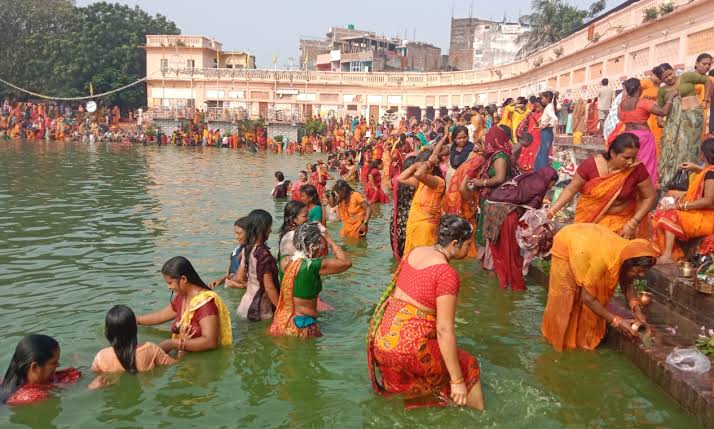
SATV, Kathmandu, October. 2- Jitiya is an extremely sensitive, cultural, and challenging folk festival celebrated by the Maithil and Tharu communities. Folk festivals are given the name of the beliefs and convictions of the community. Jitiya, derived from the Sanskrit word 'Jivitputrika', is a corrupted form. It embodies specific human activities, daily life, and achievements, which guide lifestyle in a particular direction.
In the Jitiya festival, folk deities are worshipped, not any classical deities. It is believed that mothers worship folk deities to receive blessings for the long life and healthy living of their children. The desire for blessings from folk deities by observing a strict fast for the protection of children is a manifestation of the ultimate form of maternal love.
Jitiya festival, considered a symbol of respect for motherhood, provides an understanding of the cultural depiction of a mother's affection for her child. This festival highlights the cultural role of women, freely flowing with factual elements, objects, ideas, practices, values, and traditions. Essentially, observing the Jitiya fast is believed to protect against any accidental dangers and promote lineage growth.
For this, the fast is observed with due rituals from the seventh to the ninth day of the month of Ashwin. It has been believed since ancient times that observing this fast removes all crises for children. The importance of this fast is mentioned in ancient texts as dating back to the Mahabharata era. It emphasizes purity in thought, word, and deed, bestowing life force.
Jitiya, also known as Jivitputrika Vrat or Jimutavahana Vrat, is a tradition where mothers observe the Jitiya festival with extreme discipline and strict fasting. There is a belief that Lord Jimutavahana protects and blesses children. For this, mothers observe a waterless fast for Jimutavahana deity and pray. Currently, Jitiya is not limited to religious rituals and cultural folk festivals but also exists as a special celebration.
Jitiya festival, a symbol of the continuous deep connection with various aspects of nature and environment, helps in the conservation and support of botanical wealth. The use of ridge gourd leaves, flowers, mustard oil, khari (a type of paste), coconut, cucumber, peas, banana, banana leaves, and bamboo leaves as puja materials confirms this. The worship of clay jackals and birds also highlights its uniqueness. Although there is no classical mention of these objects and materials, it is observed that products and resources from the place, region, and environment are utilized and given appropriate importance, respect, and sanctity as offerings. The mention of various plants, animals, and ponds in the puja signifies that consciousness towards nature has been ongoing for centuries.
This festival, protecting aspects of public welfare in a cultural guise, is celebrated by every caste in society. It honors motherhood and provides life force as an integral part of cultural life. 'Pitarain' is offered in reverence to deceased mothers-in-law, deceased mothers, and other revered women. The festival provides a significant platform for preserving and promoting humanity, equality, nature, and the environment. Jitiya falls under the Pitru Paksha. During Pitru Paksha, men offer libations to their deceased ancestors throughout the fortnight, while women offer 'naivedya' to deceased women during the Jitiya fast.
On the seventh day of Jitiya, 'Nahayakhay' is observed. On this day, the fasting women bathe, purify themselves, offer mustard oil and 'pena' (khari) on ridge gourd leaves, and worship Lord Jimutavahana, which is called 'Telkhari'. This 'Telkhari' is applied to the head by everyone in the family as prasad.
On the seventh day, 'Pitarain' is also observed, where 'naivedya' is offered in reverence to deceased women, and women are invited for a feast. On this day, married women traditionally eat millet (maruwa) bread and fish. Those who are vegetarian also have the tradition of eating 'gamhari' (rice that grows inside the husk) kheer or rice. The 'naivedya' on that day includes dishes made from wheat flour and jaggery, rice, lentils, yogurt, flattened rice, kheer, bread, milk, sugar, and other items offered according to lineage and tradition. In the last part of the night of the same day, the fasting women consume yogurt, flattened rice, fruits, 'amot' (a type of sweet), sweets, etc., which is called 'Othangan'. After eating, the fasting women take water in a vessel, lean against the wall near the doorstep of the house, and drink water. Since the Jitiya fast is observed on the Ashtami tithi, fasting continues until the Ashtami tithi.
On the Navami tithi, after bathing and purifying themselves, 'naivedya' is offered to Lord Jimutavahana as before, and prasad is consumed. This is how the fast is broken. This festival is also considered a difficult one because it is a rule not to swallow saliva and to observe a fast of 36 hours without food and water, and not to break the fast.
Jitiya falling on a Sunday and Tuesday is considered particularly significant. It is also called 'Khar Jitiya'. It is believed that if a person survives a major accident, their mother must have observed Khar Jitiya. The main objective of the Jitiya festival is the wish for salvation and the welfare of the family. Regarding this festival, there is a saying among the community: 'Jitiya paawani bada bhaari, dhiyaaputaake thokisutaulani, aapane khayalani bhari thaari'. This means the Jitiya festival is very grand. To observe this festival, a mother tucks her children in bed and then eats a full plate herself. However, the reality is not that; it is merely a preparatory step taken by every woman before undertaking the fast to demonstrate its sanctity and importance.
Worship of Jimutavahana
On the day of Ashtami, the fasting women bathe in a nearby pond or lake and offer libations to Lord Surya. Then, they make a vow for the fast and fill a 'daali' (basket) at home. The 'daali' is filled with fruits such as coconut, cucumber, apple, banana, and covered with a new cloth.
Around noon, women from the neighborhood gather in one place, and the fasting women narrate the importance of the Jimutavahana fast, the commencement of the festival, and stories about Lord Jimutavahana, after which everyone returns to their homes. In the evening, the courtyard is smeared with cow dung, and a small pit is dug to create a pond. A small branch of a Pakari tree is planted on the edge of the pond, and an image of a clay bird is made on the branch and an image of a jackal below the branch. A statue of Jimutavahana made of Kush grass is placed in a kalash (water pot) filled with water, and the fasting women worship Jimutavahana with fruits.
The question naturally arises: Who is Jimutavahana? According to the Bhavishya Purana, Jimutavahana was the son of King Shalivahana. Due to Lord Shiva's immense grace upon him, women who observe the fast with discipline and devotion received a boon from the Lord for the long life of their children.
In this festival, crows and jackals are also worshipped. In various festivals of Hinduism, there is a tradition of giving special importance and respect to certain birds and animals through worship. Similarly, cows, pigeons, crows, dogs, ducks, tigers, mice, and other animals are worshipped, while in the Jitiya festival, crows and jackals must be worshipped. Offering 'naivedya' to crows and jackals demonstrates affection and reverence towards birds and animals.
Jitiya Festival Story
In the middle of Kanakavati city, at the foot of a Pakari tree on the bank of the Narmada River, lived a jackal, and a crow lived on the branch. They were close friends. One day, women celebrating the Jitiya festival bathed in the Narmada River, sat at the foot of the same tree, offered prasad to Lord Jimutavahana, and narrated stories.
Hearing the story of the fasting women, the crow and the jackal also felt the desire to observe the Jitiya fast. Both decided to fast after consulting each other. That night, the body of a merchant's son was cremated on the bank of the Narmada River. The deceased's relatives left after most of the body was burnt and returned home. Seeing them leave, the jackal felt the desire to eat the dead person's flesh and, without the crow's knowledge, ate the flesh and hid some of it, which the crow observed. In due course, both died at the Kumbh Mela of Prayag.
Due to their deaths at the Kumbh, both were born into the house of a Brahmin named Bhaskar, a scholar of the Vedas. In their previous lives, the crow was born as Shilavati and the jackal as Karpuravati. The elder Shilavati married into a wealthy family, and Karpuravati married a king. The elder Shilavati had seven sons, but Karpuravati, who became a queen, had a son who died.
Years later, as their relationship grew cold, the elder Shilavati reminded her sister of the past events, stating that the death of her children in this life was due to breaking the fast, as mentioned in religious texts. For this reason, no one wishes to break the fast, no matter how difficult it is.
The mustard oil, 'pena', ridge gourd leaves, and 'naivedya' items used in the Jitiya fast are considered important from both health and cultural perspectives. The tradition of eating millet bread and fish a day before the fast and peas mixed with greens a day after highlights the diversity in food and eating habits. The mantra recited while drinking water during 'Othangan' reflects intimacy between siblings and reflects cultural beliefs.
The mystery of this folk festival and its origin are primarily linked to three mythological stories and deep spiritual beliefs. The main basis for the mystery and origin of Jitiya lies in mythological stories. The self-sacrifice of King Jimutavahana, the fast and devotion of the crow and jackal, and the story of Ashwatthama and Parikshit clarify the mystery of the festival.
The Jitiya festival is also considered a signal for the arrival of Dashain. Some women also worship ancestors during this festival. During this festival, the deceased eminent women of their lineage are remembered and worshipped. As awareness about not discriminating between sons and daughters grows, it is now also called a festival celebrated for the welfare of one's children.
Since it is believed that breaking this fast will bring misfortune to children, it is essential to understand this festival as an integral part of the social structure, encompassing social, religious, and cultural diversity. It inspires and encourages the desire for a happy family life, expresses reverence from daughters-in-law towards their ancestors, identifies culinary diversity, enhances social harmony, reflects maternal affection for children, and promotes the creation of an egalitarian civilized society, revealing the fundamental form of original culture.
This festival also involves passing on the experiences and culture of the older generation to the new generation, ensuring its continuity. The festival has not only religious or cultural but also a deep psychological essence. It strengthens the emotional bond between mother and child, enhances the determination of mothers, and fosters social unity.
Motherhood and emotional security, determination and mental fortitude, the message of righteousness, respect for maternal power, conservation of nature, and cultural vibrancy are the core philosophies of this festival.