




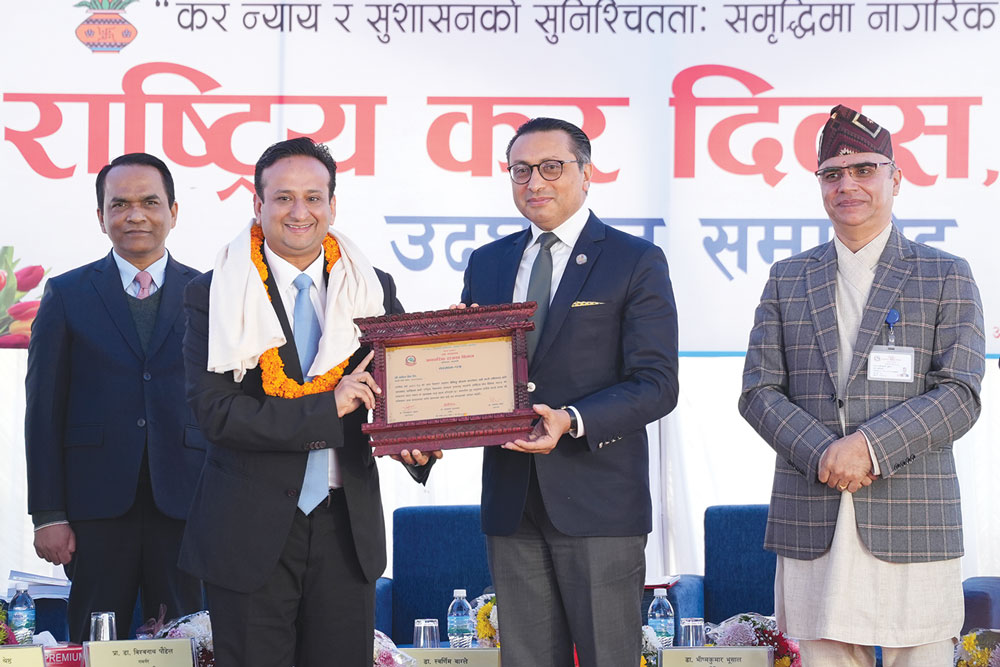
Finance Minister Dr. Swarnim Wagle has said that the government will achieve its ambitious revenue collection target of Rs. 1,580 billion for the current fiscal year through good governance, tax reforms and improved coordination between the government and the private sector.
Speaking at a programme organised to mark National Tax Day-20283, Finance Minister Dr. Wagle said that the government had set a target of increasing revenue collection by around 27 per cent compared to the previous fiscal year, when it collected around Rs. 1,250 billion.
He acknowledged that the target was ambitious, particularly as Nepal's average revenue growth rate had remained low since the COVID-19 pandemic.
However, he expressed confidence that improvements in governance and bold policy reforms would help achieve the target despite the challenging economic environment.
"With the message of bold reforms and the results of good governance, we are moving forward despite adverse circumstances. This time, our revenue collection target is quite ambitious, with a growth target of around 27 per cent compared to last year," he said.
FM Dr. Wagle said that the government was committed to making the tax system more transparent, predictable and business-friendly.
He stressed that frequent changes in tax policies could discourage private investment and undermine business confidence. While the government was ready to listen to suggestions, complaints and concerns from the private sector, he said that policy stability was equally important.
"We should not keep changing policies related to taxes every week. We should introduce reforms where necessary while ensuring policy stability and predictability for the private sector," he said.
Finance Minister has announced that a package containing 30 to 35 new economic reform programmes will be unveiled within the next week or two.
Stating that reform is a continuous process, Wagle said that they have not remained idle since the announcements of budget for the fiscal year on May 29, 2026.
The Finance Minister also urged businesses to take advantage of the favourable investment environment, saying that tax rates had been reduced, banks had sufficient liquidity, foreign exchange reserves were comfortable and the country had a stable government.
He assured that the government would not harass honest and hardworking entrepreneurs and called for greater cooperation among the government, tax administration and the private sector to accelerate economic growth.
Dr. Wagle also highlighted the government's efforts to resolve longstanding tax disputes and improve tax compliance. Businesses involved in tax disputes have an opportunity to settle their cases by paying only 1 per cent of the disputed amount until mid-January 2027, he said, urging them to utilise the provision.
He added that historic reforms had been introduced in tax rates and the tax base during the current fiscal year. The government is also preparing further reforms in customs duties and excise duties in the next fiscal year's budget, he said.
Acknowledging that the government had limited time to prepare the current year's budget, Wagle said that tax reforms would receive greater continuity in the upcoming budget.
He further stressed the need to accelerate revenue mobilisation, saying that he would personally engage in efforts to make the revenue administration more active and effective.
Acting Secretary at the Ministry of Finance Dr. Suman Dahal clarified that the government considers taxation not merely as a source of revenue but also a tool for accelerating the country's economic activities.
He said that the government had been making efforts to improve tax administration with the aim of controlling tax leakage and making the tax system more taxpayer-friendly.
President of the Nepal Chamber of Commerce Kamlesh Kumar Agrawal called for making the tax system an effective tool for promoting investment, increasing production and creating jobs rather than limiting it to revenue collection.
He said tax system reforms should focus on transparency, simplicity and building taxpayers' trust.
Highlighting challenges faced by the private sector, including weak demand, high production costs and policy instability, Agrawal urged the government to introduce investment- and production-friendly tax policies.
He also called for VAT reforms, lower customs duties, simplified taxation for small businesses and revision of the 25-year-old Income Tax Act.
President of the Federation of Nepalese Chambers of Commerce and Industry (FNCCI), Anjan Shrestha, called for reducing tax rates, saying Nepal has the lowest economic growth rate but a high tax growth rate in South Asia.
He said Nepal's tax-to-GDP ratio had reached 21 per cent, placing a heavy burden on domestic taxpayers and businesses. He urged the government to prioritise reducing the cost of doing business.
Shrestha, however, welcomed the timely introduction of the current fiscal year's budget and its provisions on income tax and customs duty cuts, loan recovery, intellectual property protection, limited liability partnerships and sunset laws.
President of the Confederation of Nepalese Industries (CNI), Birendra Raj Pandey, stressed the need for expanding the tax base rather than repeatedly increasing tax rates to boost government revenue.
He said bringing informal economic activities, assets and professions into the tax net would be more effective and equitable than imposing additional burdens on existing taxpayers. He stressed the need for stable tax policies, transparent and technology-friendly tax administration, and effective mechanisms to resolve tax disputes.
He called for linking the tax system with domestic production, exports and employment generation. IRD pledges digital transformation of tax administration. On the occasion, Director General of IRD Dr. Bhishma Kumar Bhusal presented a 15-point commitment to modernise tax administration, improve taxpayer services and ensure sustainable revenue growth.
The IRD has pledged to achieve its revenue collection target of Rs. 775 billion through technological innovation, good governance and reforms in the tax system.
It aims to clear at least 60 per cent of outstanding revenue arrears by mid-July 2027 and introduce a digital identity system for each taxpayer.
The department also plans to establish a 24-hour AI-based call centre and chatbot to address taxpayers' queries and complaints.
The department plans to introduce a 'One Taxpayer, One Digital Identity' system to securely and systematically manage taxpayers' information, business transactions and tax compliance records in an integrated digital platform.
It will also launch a nationwide voluntary tax participation campaign in coordination with local governments and the private sector. The campaign will focus on expanding tax education and encouraging people to voluntarily fulfil their tax obligations.