




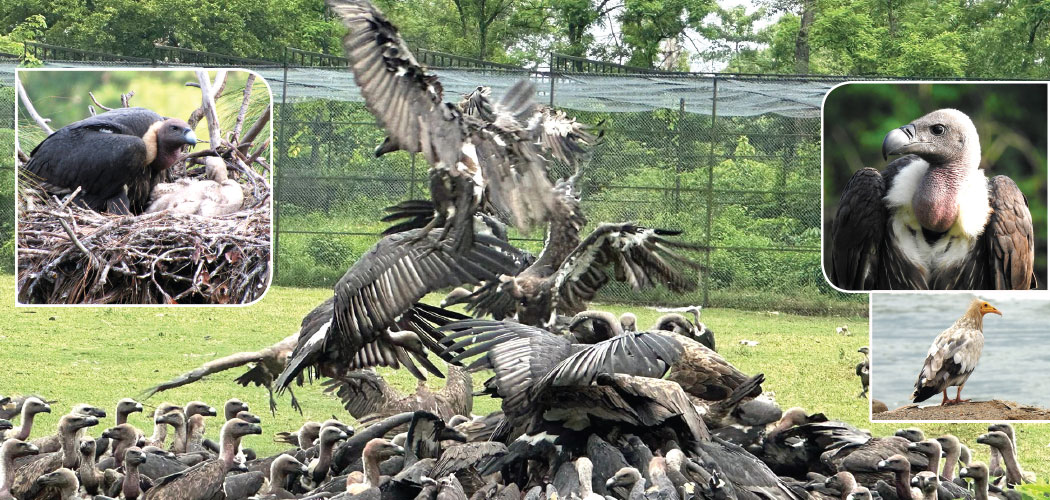
SATV, Kathmandu, Oct.9- Vultures are large-sized, efficient scavenging birds, feeding mostly on the carcasses of dead animals and are found on every continent except Antarctica and Oceania. Vultures play a highly important ecological role through the rapid consumption of animal carcasses. They safely dispose of dead animals and help in preventing the spread of zoonotic diseases such as rabies, anthrax, tuberculosis and brucellosis.
Vultures also have an important cultural role. In sky burials practised in Nepal and Tibet, the dead are cut into pieces and offered to vultures following the advice of priests. This practice is associated with the Lama people of the Trans-Himalayan region and other communities, including the Sherpa. In the dry Himalayan environment, where burial and cremation can be difficult, vultures help dispose of human remains. In Hindu mythology, a vulture is said to be the carrier of Shani (Saturn), while the vulture Jatayu fought Ravana in an attempt to rescue Sita in the Ramayana.
Vultures were common in Nepal in the 1990s but faced a dramatic population decline across the Indian subcontinent in the early 2000s. The major cause was the veterinary drug diclofenac, which was widely used to treat livestock in Asia. Vultures are highly susceptible to the drug and are exposed when they feed on the carcasses of treated animals. Consuming sufficient amounts of diclofenac-contaminated tissue can cause kidney failure and visceral gout.
Of the nine vulture species found in Nepal, four—the White-rumped Vulture, Slender-billed Vulture, Red-headed Vulture and Indian Vulture—are listed by the IUCN as Critically Endangered, the highest category of endangerment. The Egyptian Vulture is Endangered, while the Himalayan Griffon and Bearded Vulture are classified as Near Threatened.
Nepal has implemented both in-situ and ex-situ conservation measures to halt and reverse the decline. One of the initial challenges was the process of withdrawing diclofenac from the veterinary market with little awareness in government circles, civil society, and the private sector. Another difficulty was the magnitude of the task and the necessity of coordinating conservation efforts over large areas.
In Nepal, the production and use of veterinary diclofenac have been prohibited since 2006, and Vulture Conservation Action Plans for 2009-2013, 2015-2019, and 2023-2027 were adopted. The purpose of such programs is to save the existing vulture species through re-introduction, food safety measures, protecting the natural habitat, and studying the ecological importance of vultures with the ultimate purpose of ensuring the viable population of wild species.
Nepal's vulture recovery programme, initiated in 2002, has adopted a participatory approach involving advocacy, education, monitoring, research, captive breeding, supplementary feeding and site protection. Over the past two decades, government agencies, conservation organisations, communities, veterinarians, pharmacies and livestock owners have worked together to protect vultures.
The country pioneered the concept of working with local communities to establish Vulture Safe Zones (VSZs) in 2009. Sustained efforts and partnerships led to the declaration of the world's first Vulture Safe Zone—the Gandaki-Lumbini VSZ—in Nepal in 2021. The zone covers nesting, roosting and foraging areas in Gandaki and Lumbini provinces.
The declaration was based on pharmacy surveys showing that veterinary diclofenac had been removed from sale, the absence of NSAID-related mortality among GPS-tagged vultures and high survival rates typical of Gyps vultures. The removal of diclofenac and increased use of meloxicam, a vulture-safe alternative, have contributed to population recovery. The recovery of two Critically Endangered vulture species in Nepal has been linked to progress in the Vulture Safe Zone programme.
The Gandaki-Lumbini VSZ was declared during the 11th annual general meeting of Saving Asia's Vultures from Extinction (SAVE) on December 2, 2021. Following Nepal's lead, Vulture Safe Zones are being implemented in Cambodia, Myanmar, Bangladesh, India, Pakistan and African countries. SAVE, a consortium of 24 partners working to conserve Asia's threatened vultures, leads this approach. Nepal's partners include the Department of National Parks and Wildlife Conservation, National Trust for Nature Conservation and Bird Conservation Nepal.
Nepal also established the world's first community-managed Vulture Safe Feeding Site, known as a Jatayu Restaurant, in 2006 at Pithauli, Kawasoti, Nawalparasi. Similar sites have since been established at six other locations. These facilities collect old and unproductive cattle from nearby villages, keep them for at least seven days to ensure they are free of diclofenac and feed their carcasses to vultures after natural death.
Jatayu Restaurants link biodiversity conservation with ecotourism and livelihood opportunities. They also provide shelter for aged and unwanted cattle that might otherwise become a burden on farmers. Communities around these sites have developed plans to conserve vultures and other wildlife while promoting sustainable practices and eco-tourism.
Scientific research has shown encouraging signs of recovery. The White-rumped Vulture, one of South Asia's most endangered birds, has continued to increase in Nepal since around 2012–2013. A recent study found that its population grew by about 12.7 per cent annually from 2013 to 2025.
GPS tracking of wild White-rumped Vultures found estimated annual survival rates of 94.7 per cent for adults and 95.5 per cent for immature birds. The study identified adult survival as the most important factor influencing population growth. Between 2007 and 2025, 6,410 nests were monitored, with an average of about 69 per cent successfully producing young. Nesting success also increased over time, indicating that vultures are not only surviving but reproducing successfully.
Despite this progress, the recovery remains vulnerable. Although veterinary diclofenac has been removed from Nepal, other vulture-toxic drugs, including nimesulide, aceclofenac and ketoprofen, have recently been banned but may still be available in the market. All vulture-toxic drugs used in veterinary medicine must be removed from the environment to ensure the continued recovery of Critically Endangered species.
Other threats, including carcass poisoning, human persecution, electrocution and localised shortages of food caused by alternative carcass-disposal practices, could also limit population recovery. Continued efforts to strengthen Vulture Safe Zones are therefore essential. Because vultures move across borders, stronger transboundary cooperation with India is also needed at both conservation and government levels.
The story of the White-rumped Vulture offers a powerful lesson: a species can decline from abundance to the brink of extinction in a remarkably short time, but concerted conservation can bring it back. After more than a decade of recovery, the results are visible in Nepal's skies. This success, however, cannot be taken for granted. It depends on the choices made today.