




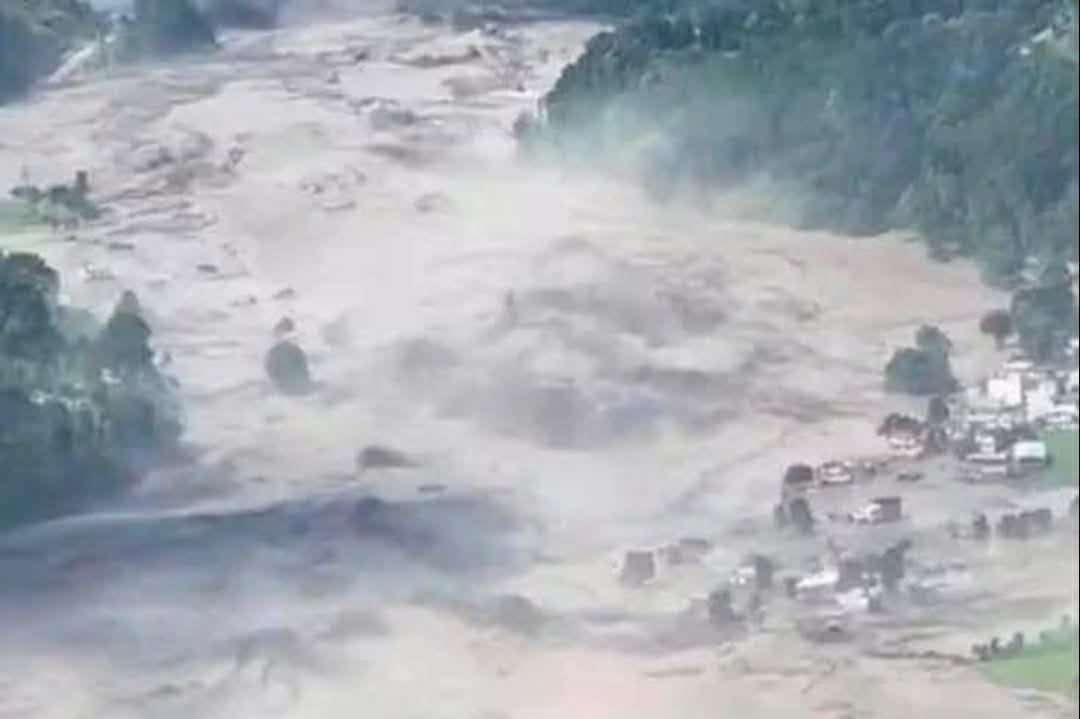
SATV, Kathmandu, October 2- More than a month after the Bhotekoshi flood swept through hydropower projects in Rasuwa and neighbouring districts, the search for missing workers and employees has entered a new phase.
The government has shifted from a regular search-and-rescue operation to what it calls a “search and recovery” effort, as the possibility of finding missing people alive has diminished after prolonged searches.
The 37th meeting of the National Disaster Risk Reduction and Management Executive Committee decided to continue search and rescue in critical and highly sensitive locations, while prioritising the recovery of bodies and damaged structures in other areas.
The change has also affected the way hydropower projects are conducting searches.
According to Bijay Mohan Bhattarai, secretary of the Independent Power Producers’ Association of Nepal (IPPAN) and manager of the Langtang Khola Hydropower Project, most of the immediately accessible areas have already been searched.
“Wherever we needed to look, we have already looked. After discussions with the security agencies, it has been decided not to continue the search in the same way,” he said.
The focus is now shifting towards relief, reconstruction and restoring infrastructure damaged by the flood.
But before hydropower companies can begin rebuilding their projects, they face another major obstacle — getting back to their project sites.
First the roads and bridges, then the projects
The flood severely damaged access roads leading to hydropower projects. In several locations, roads were completely washed away, while bridges will have to be rebuilt before equipment and workers can reach the sites.
The government is working on roads and bridges up to Betrawati, but additional infrastructure will be needed to reach projects further upstream, Bhattarai said.
“A Bailey bridge still needs to be installed at Betrawati, and there is no road beyond that,” he said. “Around a kilometre of road in the Bhotekoshi area beyond Chilime has been completely destroyed and needs to be rebuilt.”
Another Bailey bridge will also be required further along the route, meaning it could take considerable time before some project sites become accessible again.
“Until the road reaches the sites, nobody can move forward,” Bhattarai said.
Projects around the Chilime area may become accessible relatively sooner, but reaching those located further upstream could take much longer. Bhattarai estimates that access to some projects could take as long as a year.
Search operations give way to reconstruction planning
An official at the Ministry of Energy said the ministry is no longer directly coordinating daily search-and-rescue operations as it did immediately after the disaster.
Relevant hydropower projects, the Nepal Electricity Authority and security agencies are continuing necessary work, while the ministry has begun focusing on how reconstruction should proceed.
“Our focus is now on how to move ahead with rehabilitation. Planning is under way,” the official said. “We are preparing a matrix to determine which issues require political decisions and which can be handled under the existing arrangements.”
The shift reflects a broader change in the government’s response — from immediate rescue operations towards long-term recovery and reconstruction.
Rebuilding projects while displaced families wait
Hydropower companies say reconstruction cannot be separated from the problems facing families affected by the flood.
Many residents around the project areas have lost their homes and remain in difficult circumstances, according to Bhattarai.
“First, there is the issue of resettling people. Some have lost their homes altogether,” he said. “We may not be in a position to enter the project areas until their problems and those of other affected people are addressed.”
He said relief and resettlement programmes for affected communities and reconstruction of hydropower projects should therefore move forward together.
Projects face billions in reconstruction costs
The flood directly affected hydropower projects including Chilime, Langtang and Rasuwagadhi in Rasuwa. Some were nearing completion, while others were already generating electricity.
For project developers, the challenge is not only how long reconstruction will take but also how to finance the additional costs.
The impact is particularly significant for projects that were about to begin generating electricity or had only recently entered operation.
“Our project was hit just two or three days before it was due to start generating electricity,” Bhattarai said. “Now, after having to spend again, the project itself has reached a point where its financial viability is under pressure.”
Private developers are seeking policy measures including extensions to licence periods, adjustments to bank interest and loan repayment schedules, and provisions to account for a new generation period following reconstruction.
Waiting for government support
Private hydropower developers say they are prepared to rebuild, but they are waiting for the government to restore access infrastructure and introduce measures to ease the financial burden.
“There is no alternative to rebuilding the projects. They have to be rebuilt,” Bhattarai said. “But the government needs to facilitate a few things. Otherwise, it will be difficult.”
Discussions are under way between the private sector and government on issues including access roads, licence periods, bank interest and the period of electricity generation following reconstruction.
“We cannot move forward with vague assurances,” Bhattarai said. “The government says it will move ahead with relief and policy measures. We are waiting for that.”
The government’s decision to move towards a search-and-recovery phase comes as the number of people still missing following the Rasuwa-Bhotekoshi floods and subsequent monsoon-related disasters remains high.
According to government data cited by officials, 5,285 people remain missing.
For the hydropower sector, rebuilding will depend heavily on what happens outside the project sites — when roads and bridges are restored, how affected families are resettled and what financial and regulatory support the government provides.
Until those pieces fall into place, many of the hydropower projects damaged by the Bhotekoshi flood remain inaccessible — and reconstruction cannot fully begin.