




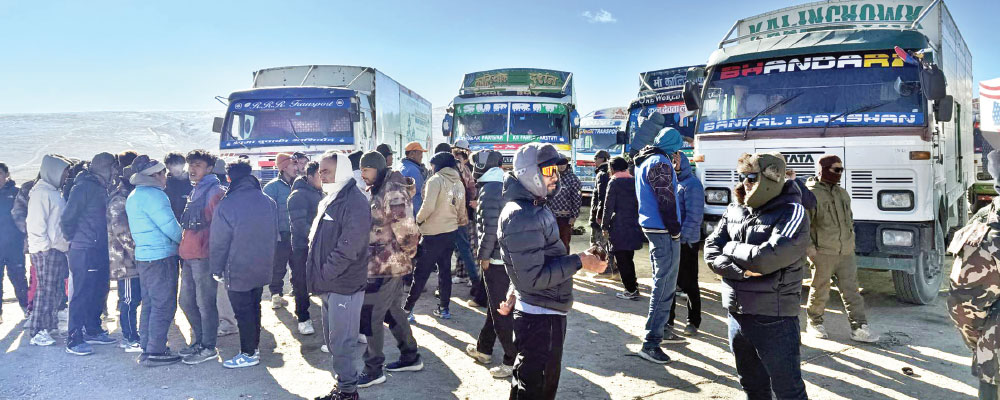
SATV, Kathmandu, Sept. 9: The devastating flash flood in the Bhotekoshi River in Rasuwa has severely disrupted Nepal-China trade after damaging infrastructure at the Rasuwagadhi-Kerung border and the connecting road network, raising concerns over the timely supply and prices of Chinese goods ahead of the major festival season.
The damage to the Rasuwagadhi border and connecting roads has disrupted the movement of cargo trucks carrying goods imported from China, forcing traders to look for alternative routes at a time when demand for consumer goods is expected to surge ahead of Dashain, Tihar and Chhath.
Ram Hari Karki, president of the Nepal Trans-Himalayan Border Commerce Association, said challenges had emerged in importing goods from China to meet the immediate demand for festival-related goods following the damage to the Rasuwagadhi border.
He said the disruption could affect the supply of festival-related goods and increase transportation costs.
“More than 500 to 600 Chinese containers carrying goods for Teej, Dashain, Tihar and Chhath were moving from China towards Kerung. Many of these cargoes have been stranded after the Rasuwagadhi border was damaged,” he said.
In the meantime, more than 200 Nepali containers were swept away by the floods. “The floods swept away 200 containers, while businessmen have suffered losses of at least Rs. 2 billion,” he said.
Besides, several businessmen were killed in the floods.
Rasuwagadhi is one of Nepal’s major trading points with China and handles a significant volume of Chinese imports. The situation has become more challenging for traders as the Tatopani border, another important Nepal-China trade route, is also not operating normally.
With both major northern routes disrupted, traders have been compelled to divert cargo through the Korala border in Mustang, said Karki.
According to Karki, around 176 cargo trucks have already been diverted towards Korala.
However, he said the route could not serve as a practical year-round alternative to Rasuwagadhi because of its difficult terrain, high altitude and longer transportation time.
“Using the Korala border is our compulsion, not an alternative,” Karki said.
There was a problem importing goods stranded at Kerung through the Tatopani border after the Chinese government temporarily closed the border until further notice, said businessman Narayan Pandit.
“If the Tatopani customs point is reopened, we can divert some of the containers to Tatopani and some to Korala from Kerung. This will help us bring the imported goods on time,” he said.
Higher transportation costs
The diversion of cargo through Korala is expected to increase both transportation time and import costs.
Karki said it could take at least 10 to 12 days to transport cargo from China to Nepal and back through the Korala route, compared with the relatively shorter routes previously used by traders.
“Korala is a long route for China-Nepal trade. It takes at least 10 to 12 days to bring cargo from China through this route. This will increase both the cost and time of trading,” he said.
According to traders, the transportation cost of a cargo vehicle travelling from the Korala border to Kathmandu is currently around Rs. 450,000 to Rs. 500,000. This represents an increase of around 10 to 15 per cent in transportation costs, Karki said.
Chinese goods account for a substantial share of merchandise sold in Nepal during the festival season. Traders import garments, footwear, electronics, electrical goods, household items, decorations, toys and other consumer items from China.
Traders are now concerned that goods already ordered for the festival season may not reach the Nepali market on time because of the longer route and disrupted border infrastructure, said businessman Narayan Pandit.
“Traders are worried about bringing goods already ordered from China on time for the upcoming festivals because of the longer route,” he said.
During the three months from Saun to Ashoj, around 6,000 Nepali cargo containers carrying goods enter Nepal through the Rasuwagadhi border every year.
“Depending only on the Korala route will definitely create challenges in bringing the required goods from China, as vehicles will have to queue for customs clearance,” said Pandit.
Even last year, traders importing goods from Kerung were affected after a bridge at Rasuwagadhi was damaged by floods.
Tatopani needed as immediate alternative
They have urged the government to take diplomatic and administrative initiatives to resume smooth operations at the Tatopani border to ease pressure on the country’s northern supply chain.
Karki said Tatopani could serve as a more practical alternative to the damaged Rasuwagadhi route because of its relatively shorter distance to Kathmandu and better road connectivity on both sides of the border.
“Tatopani is an important trading point between Nepal and China. It takes only around six to seven hours to transport goods from Tatopani Customs to Kathmandu,” he said.
He said the roads on both the Nepali and Chinese sides of the Tatopani route are relatively well connected, making it a viable option for maintaining the flow of Chinese imports during the disruption at Rasuwagadhi.
“The government should immediately take diplomatic initiatives for the smooth operation of Tatopani Customs,” Karki said.
Pandit, who has been importing footwear from China for more than two decades, said it was essential to bring the Tatopani border into operation to facilitate imports from China and reduce the pressure on vehicles at Korala following the closure of the Rasuwagadhi border.