




Nepal and India have agreed to make the existing unidirectional B345 Kathmandu-Bhairahawa-Lucknow air route, bidirectional.
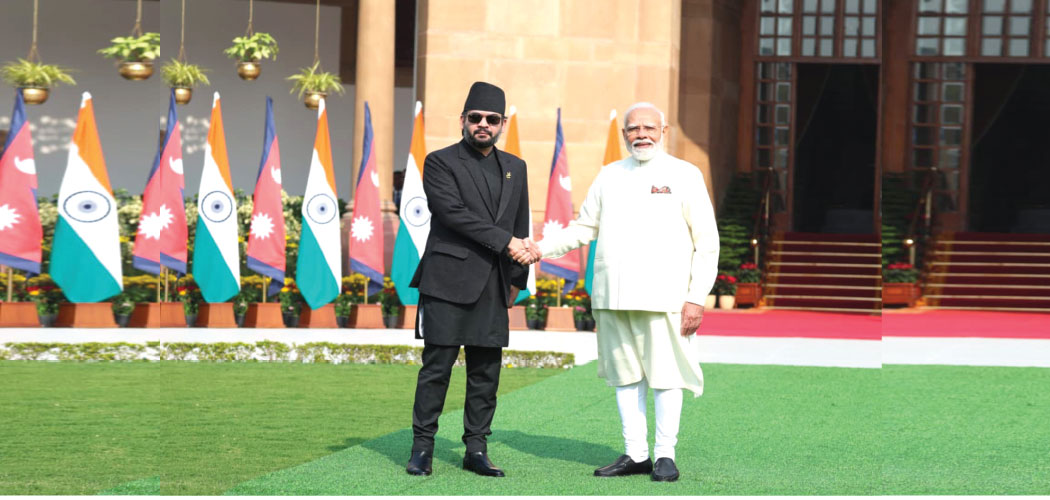
Technical consultations will be held to finalise the modalities in this regard and to address other civil aviation proposals from both sides currently under discussion, read a joint statement issued by Prime Ministers of Nepal and India Balendra Shah and Narendra Modi upon the completion of the former's two-day state visit to India, on Monday.
Prime Minister Modi reaffirmed India’s unwavering support to Nepal’s development journey as a close friend and neighbour, and announced development assistance of Rs. 240 billion (INR 150 billion).
The assistance will include grant assistance of Rs. 56 billion for post-disaster reconstruction and new infrastructure projects in Nepal and a Rupee-denominated Line of Credit of INR 115 billion (Rs. 184 billion) for energy sector projects. "Specific projects as well as modalities for the provision of development assistance will be finalised through mutual consultations," read the joint statement.
Likewise, PM Modi announced a new connectivity avenue for Nepal’s transit trade through Deendayal Port (Kandla, Gujarat). Further, access to Paradip Port (Odisha) will also be made available once requisite infrastructure is in place. The two leaders underlined the importance of improving cross-border connectivity and enhancing border infrastructure, through the establishment of new railway lines, bridges, Integrated Check Posts (ICPs) and petroleum pipelines.
They laid virtually the foundation stone for a new ICP at Banbasa border in Kanchanpur district and welcomed the progress in the construction of the ICPs at Bhairahawa, Sunauli and Dodhara-Chandani. Three ICPs between India and Nepal are already operational. A new cross-border motorable bridge between Dharchula (India) and Darchula (Nepal) was also inaugurated by the leaders. The statement said that this will help improve direct connectivity between Western Nepal and India.
Similarly, the two Prime Ministers flagged off the inaugural Sarayu-Kamala Express rail service between Ayodhya and Janakpur. This rail service will not only improve connectivity but also give a fillip to religious and cultural tourism along the Ramayana Circuit, and strengthen the civilisational ties between India and Nepal. The leaders agreed to explore similar connections to develop Buddhist and Shiva-Shakti religious tourism circuits.
Support announced for railway, petroleum infrastructure
The two leaders announced the finalisation of the Field Location Survey for the proposed Raxaul–Kathmandu electrified broad-gauge railway line, and announced that the two sides will collaborate in the development of the East-West Railway in Nepal.
Noting the satisfactory progress in joint field work relating to maintenance and repair of boundary pillars, they directed the foreign secretaries to work on the outstanding boundary issues.
In an expansion of cross-border petroleum infrastructure between India and Nepal, Prime Ministers Shah and Modi dedicated to the people of Nepal phase II of the Motihari-Amlekhgunj Pipeline.
The two leaders also laid virtually the foundation stone for the development of a petroleum terminal at Jhapa, Nepal and emphasised the importance of early commencement of work on the petroleum pipeline between Siliguri and Jhapa.
Both sides agreed to explore cooperation in the construction of gas pipelines between India and Nepal, according to the statement.
Likewise, both sides expressed satisfaction at the bilateral progress in the hydropower sector, in keeping with the India-Nepal Joint Vision Document for Power Sector Cooperation and the Long-Term Power Trade Agreement.
They welcomed the active engagement of Indian companies in the hydro-power sector in Nepal, and agreed to ensure the expeditious completion of various hydropower projects being developed by Indian companies in Nepal. On this occasion, the two leaders laid virtually the foundation stone for the 669 MW Lower Arun Hydro-Electric Project.
They also noted with satisfaction the ongoing progress in the implementation of development projects in Nepal, including the High Impact Community Development Projects (HICDP), in the construction of the National Police Academy in Nepal, being built with assistance from India. Both leaders also welcomed the announcement of setting up an Agro-Industrial Park in Chitwan with grant assistance from India.
Pancheshwor to get momentum
According to the joint statement, the two leaders directed the Pancheshwar Development Authority and the Joint Committee on Water Resources to finalise the Detailed Project Report of the Pancheshwar Multipurpose Project expeditiously and commence work on the implementation of the project. They also agreed on the need to accelerate work on the DPR of the Saptakoshi and Sunkoshi multipurpose projects to harness water resources for mutual benefit and mitigate the impact of floods.
The two sides noted with satisfaction the progress regarding the formation of joint-venture for two high-capacity cross-border transmission lines between Inaruwa (Nepal) - New Purnea (India) and Dodhara (Nepal) – Bareilly (India).
In an expansion of India’s development and capacity-building support to Nepal, the two leaders agreed that India would set up an off-shore IIT campus in Nepal. This will serve as a force-multiplier in Nepal’s education sector and also promote job creation.
PM Shah and Modi adopted a Joint Vision for a 'Viksit Bharat and Samunnat Nepal', and stated that the joint vision statement provides the roadmap for an aspirational and future-oriented partnership between India and Nepal. It encompasses initiatives to augment traditionally strong areas of bilateral cooperation such as economic and development partnership, connectivity, energy and water resources, and people-to-people linkages, as well as new synergies in the domains of climate resilience, disaster mitigation and management, sports, start-ups, digital services, space and innovation.
Eight MoUs were exchanged on the occasion.
PM Shah expressed his gratitude to PM Modi and formally invited him to visit Nepal. PM Modi accepted the invitation, with the official dates for the visit to be confirmed through diplomatic channels.
PM Shah calls on President of India
PM Shah called on President of India Droupadi Murmu at Rashtrapati Bhavan. The President said that the strong foundation of unique and multifaceted ties between the two countries is based on our shared civilizational heritage and the deep cherished bonds between our peoples, the President's Office wrote in a post on X.
According to the Ministry of Foreign Affairs (MoFA), the two leaders held comprehensive and productive discussions on the whole gamut of Nepal-India relations, focusing on expanding bilateral trade and investment, strengthening energy cooperation, enhancing connectivity and further deepening people-to-people ties.
They also exchanged views on the key areas of mutual interest and underscored their commitment to further strengthening the longstanding relationship between Nepal and India.
Earlier, on Sunday, External Affairs Minister of India Dr. S. Jaishankar had called on PM Shah where they discussed bilateral trade, transit and connectivity issues.
Prime Minister Shah acknowledged with appreciation India’s humanitarian and technical support and solidarity in the aftermath of the devastating Rasuwa-Bhotekoshi floods that caused significant loss of life and destruction of property in Nepal.
Concluding his maiden bilateral trip to India, PM Shah returned to Kathmandu on Monday evening. Officiating Prime Minister Biraj Bhakta Shrestha received him at the Tribhuvan International Airport.
Milestone visit: FM Khanal
Foreign Affairs Minister Shisir Khanal said the visit has proved to be a milestone in creating a cordial environment for economic development and prosperity through more dynamic neighbourly relations.
"It has also been a milestone in enabling Nepal to reap appropriate benefits from the significant development and prosperity achieved by its neighbouring country," he said while talking to journalists upon his arrival at the Tribhuvan International Airport.
According to him, the discussions and high-level meetings held during this visit have taken Nepal-India diplomatic, economic and development cooperation to a new level, while laying a strong foundation for advancing result-oriented cooperation in areas of mutual interest in the days ahead.
"Furthermore, the visit has been a complete success in promoting bilateral interests by fostering mutual understanding of each other’s sensitivities and addressing them appropriately through mutual coordination with the friendly neighbouring country," said FM Khanal while adding that it will remain a historic achievement for Nepal and the Nepali people.