




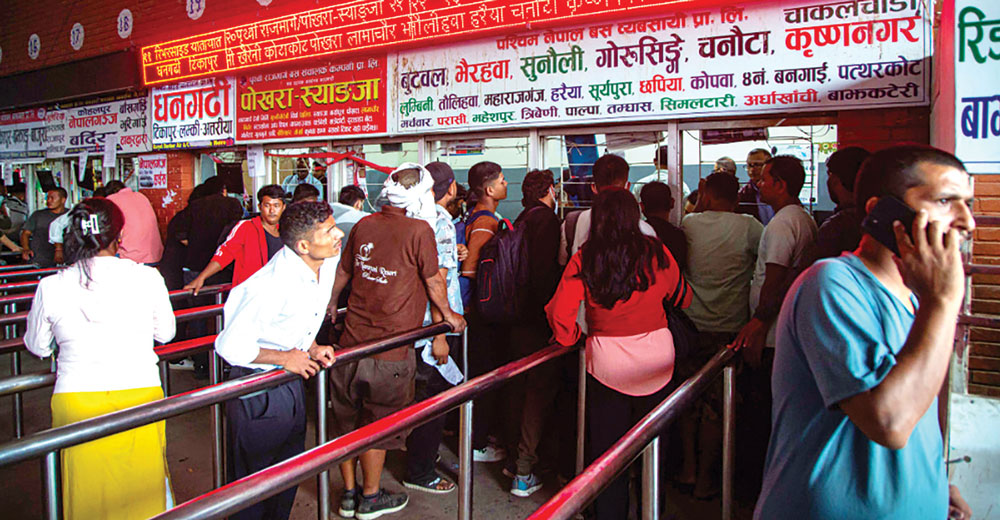
SATV, Kathmandu, Oct. 5- Around 1.5 million people are expected to leave Kathmandu Valley for their hometowns during the Dashain festival, with nearly one million travelling by public transport, putting heavy pressure on the capital’s roads and transport infrastructure.
A report titled Public Transport Travel Management for Dashain Festival 2083, prepared by the Infrastructure Development Committee of the House of Representatives with technical support from the Society of Transport Engineers, Nepal (SOTEN), has warned of possible traffic congestion, ticketing irregularities and road safety risks during the festival rush.
Prepared under the chairmanship of committee chair Ashish Gajurel, the report is based on traffic data, road-condition assessments and an online passenger survey.
The busiest travel period is expected from October 17 to 19, from Fulpati to Ashtami, when 200,000 to 300,000 people are expected to leave the Valley. Fulpati alone could see around 113,283 passengers departing, requiring about 7,367 public vehicles.
Overall, an estimated 43,574 to 65,361 public transport trips will be required during the Dashain travel period, according to lawmaker Gajurel. The report estimates that 48 per cent of departing public vehicles will be large buses, 43 per cent microbuses and nine per cent minibuses. Another 150,000 to 250,000 passengers are expected to leave the Valley before Ghatasthapana.
Nagdhunga faces heavy pressure
Nagdhunga, Sanga and Pharping handle around 85-90 per cent of vehicle movements into and out of the Valley, with Nagdhunga expected to face the greatest pressure, particularly on the Narayangadh-bound corridor.
According to the report, 27 per cent of passengers travel towards Pokhara, 21 per cent towards Butwal, 19 per cent towards Narayangadh, 18 per cent towards Mugling and Dhading, and 15 per cent towards Lumbini and Chitwan.
It recommends diverting east-bound traffic through the BP Highway and Kanti Lokpath, which could reduce pressure on Nagdhunga by 15-20 per cent. It has also proposed prioritising passenger buses and microbuses through the Nagdhunga Tunnel once operational, while directing freight and slower vehicles to the existing road.
Advance ticket booking uncertain
The delay in opening advance ticket booking for Dashain has left passengers uncertain about travel arrangements.
Some transport companies have started online bookings, particularly for destinations such as Pokhara, Chitwan and Bhairahawa, where transport options are readily available. However, advance bookings for remote and less accessible destinations have not yet been formally opened.
Saroj Sitaula, President of the Federation of Nepalis National Transport Entrepreneurs, said they were holding almost daily discussions with government agencies, but there was still uncertainty over when ticket bookings would open.
The report has also highlighted widespread ticketing and fare-related problems. According to the SOTEN survey, 43 per cent of respondents had faced difficulties obtaining Dashain tickets, while 30 per cent said they had paid more than the prescribed fare. Only 24 per cent reported securing tickets without difficulty.
The survey shows a growing preference for digital booking, with 52 per cent favouring mobile apps or websites, 28 per cent telephone reservations and only 17 per cent preferring bus counters. Meanwhile, 69 per cent preferred starting their journey before 9 am, suggesting the need for staggered departures and better advance scheduling.
Damaged roads add to safety concerns
Recent floods, landslides and heavy rainfall have damaged several highways and roads, including sections of the Bhotekoshi corridor, BP Highway and Prithvi Highway, raising concerns over travel time and passenger safety.
The Department of Roads has intensified maintenance and repair works and plans to deploy 53 heavy equipment, including bulldozers, excavators and loaders, at vulnerable locations for emergency road clearance.
The Araniko Highway, BP Highway, Sankhu-Melamchi road, Balkhu-Dakshinkali road and Tribhuvan Rajpath have been identified as priority routes.
Stronger enforcement proposed
The parliamentary report has recommended deploying two drivers on journeys exceeding 250 kilometres or eight hours, mandatory vehicle fitness checks and stricter monitoring of driver fatigue, alcohol and drug use.
It has also called for an end to indiscriminate roadside passenger pick-ups along the Kalanki-Sitapaila-Nagdhunga and Koteshwor-Kalanki sections, requiring buses to use designated terminals and bus parks.
A three-shift traffic police system, stronger passenger grievance mechanisms through 103, 100 and Hello Sarkar, and passenger assistance desks at 15 key locations have also been proposed. For long-term reform, the committee has recommended establishing a Public Transport Authority for Kathmandu Valley, along with wider use of automatic number-plate recognition, GPS tracking and mandatory digital ticketing.
With millions preparing to travel home for Dashain, authorities face the challenge of ensuring sufficient public transport while keeping roads safe, fares regulated and traffic manageable during one of the country’s busiest annual travel periods.