




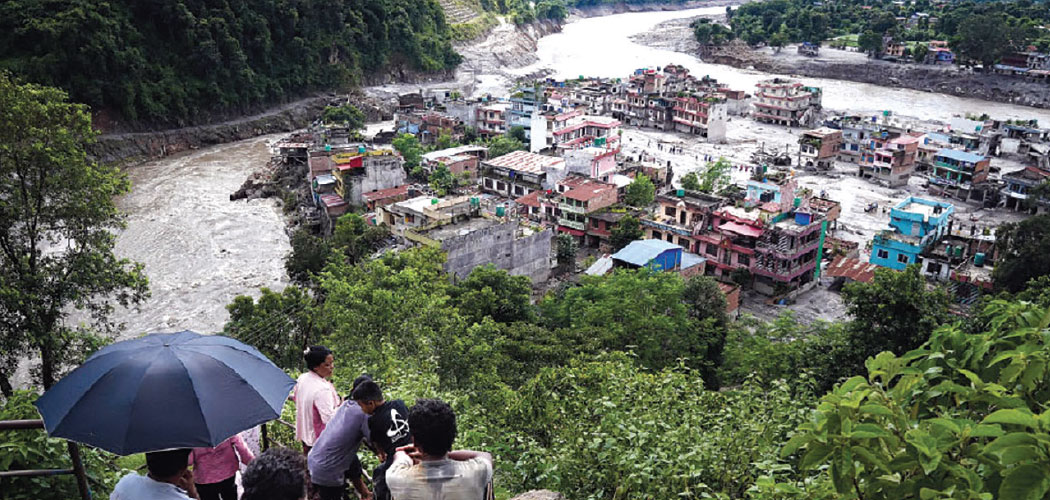
Satv, Kathmandu, Nov. 29: Nearly 100 days have passed since the devastating Bhotekoshi disaster, but hundreds of displaced people in Rasuwa, Nuwakot and Dhading are still living in temporary shelters, struggling to rebuild their lives. Although the government said it has stepped up recovery and reconstruction efforts, survivors complained that they have yet to receive even basic relief support from the government.
As winter approaches, displaced families are increasingly worried about their living conditions, particularly the elderly, children, pregnant women and persons with disabilities, who are among the most vulnerable in temporary settlements.
Buti Tamang, Bhotekoshi disaster survivor originally from Gogane village in Rasuwa, has endured repeated displacement and upsetting personal losses. Her village was first affected by the 2015 earthquake (2072 BS). The situation was further complicated by underground blasting associated with a 216 MW hydropower project, forcing her and 92 other households to leave the village.
The entire village relocated to Bogate Taar, where they lived for two years. They later moved to Khalte Bagar, settling on government land as they could no longer afford to pay rent.
Her family was again struck by disaster when a devastating flood swept through the settlement of all 92 households, killing almost all members of her family. She lost her husband, parents, siblings and several other relatives in the flood, while she narrowly escaped by riding a motorcycle uphill.
She is now living in a temporary tent with her four children, one of whom is studying at a college in Kathmandu. She said she had received no government assistance in the form of food and financial support and had been relying entirely on non-governmental organisations for survival. She also claimed that relief distribution by non-governmental organisations had faced police intervention and obstruction, adding to the difficulties of families already struggling to rebuild their lives.
Similarly, Devaki Poudel, founder of the Nuwakot chapter of Women for Human Rights, Single Women Group (WHR) and president of WHR Bagmati Province, said around 800 to 900 displaced people were still living in temporary shelters across five sites in Bidur Municipality-5 alone.
The sites include Bada Chautara, Post Bahadur Bogati Park, Chandra Jyoti, Thulo Gau and the Kodobari holding centre, which accommodate 85 households. Many survivors, particularly single women, pregnant teenagers, new mothers, elderly people, persons with disabilities and children, are facing difficult living conditions as winter intensifies.
She said local authorities were still awaiting policy guidelines from the central government to address the needs of an estimated 2,600 to 2,700 affected households in Nuwakot, including displaced families from Rasuwa.
In the meantime, local volunteers and a women's rights organisation have been providing counselling, food and clothing, medical home visits and assistance coordination. Poudel also highlighted community-led efforts to support displaced families, including the involvement of single women in managing temporary shelters. Among them is a woman from Rasuwa who lost 51 family members in the disaster but has taken responsibility for helping manage the Kodobari holding centre.
Government efforts towards recovery and reconstruction
The government says it has shifted its focus from search, rescue and relief operations to recovery and reconstruction. It has identified 44 possible resettlement locations in Rasuwa and Dhading and constructed more than 36 temporary houses and 50 transitional shelters. However, few affected families have moved into the transitional shelters, with many continuing to arrange accommodation on their own.
Ram Bahadur KC, Under Secretary and spokesperson for the National Disaster Risk Reduction and Management Authority (NDRRMA), said the Council of Ministers had decided on September 10 to provide Rs. 15,000 per household per month for temporary accommodation for six months.
The process of identifying, registering and verifying eligible beneficiaries is almost complete, he said.
The government is also coordinating with development partners and humanitarian organisations to provide financial assistance and other support while avoiding duplication of relief distribution.
More than a dozen organisations, including the Nepal Red Cross Society and the World Food Programme (WFP), have partnered with the government to support affected households. The WFP provided Rs. 45,000 each to 5,216 households before Dashain and is preparing to provide an additional Rs. 45,000 to the same households. Similarly, the Nepal Red Cross Society has been providing Rs. 15,000 per household.
The United Nations Resident Coordinator's Office has been coordinating the support provided by these organisations. The government is maintaining records of assistance to prevent duplication and ensure that eligible families who have not received support from other organisations are covered.
KC said more than 126 houses had already been constructed with support from various organisations before Tihar. The government has also received applications from more than 44 organisations interested in supporting the construction of temporary, transitional and permanent shelters.
Discussions with these organisations have focused on housing designs, construction costs and eligibility criteria, with greater emphasis on long-term housing solutions and the resettlement of displaced communities.
Existing government provisions allow up to Rs. 50,000 for a transitional shelter. However, with support from development partners and other organisations, the estimated cost of constructing such shelters could range from Rs. 300,000 to Rs. 600,000 per unit, KC said.
The government has also taken an initiative to support children orphaned by the disaster. A newborn girl whose father died in the August 26 Bhotekoshi flood will receive long-term financial and family support until she turns 18. The initiative aims to ensure that children affected by disasters remain with their families and grow up in a safe and caring environment.
Experts call for risk-sensitive reconstruction
Dr. Basanta Raj Adhikari, a Himalayan geoscientist and disaster risk reduction expert, said the government had formed a Parliamentary Committee to discuss the way forward for reconstruction.
The committee is expected to invite experts from different fields, including himself.
He said a key question was whether affected families should be encouraged to continue living along river corridors or relocated to safer areas at higher elevations. Identifying safe locations and determining an appropriate approach to reconstruction are among the major issues under discussion.
While some houses along river corridors were completely destroyed, others suffered partial damage, with residents already beginning to clean up and return to their homes. He stressed the need for the government to introduce new and innovative reconstruction approaches promptly so that affected communities could follow appropriate rules and regulations.
“Currently, the government is doing a post-disaster needs assessment which will decide how to go forward. Experts like us, we are advocating for risk-sensitive land zoning. The Government of Nepal has to strictly implement risk-sensitive land use zoning based on scientific evidence,” he said.
Need to document disaster processes
Dr. Adhikari also stressed the need for the government to properly document the entire disaster process, including its causes, impacts and response mechanisms, to improve preparedness for similar events in the future.
He said that although the government had documented physical impacts, including the number of deaths and the extent of damage, it had not adequately documented the processes involved in managing the disaster.
“Proper documentation is very important for future planning. We need to understand the different aspects and processes of a disaster so that we can prepare ourselves for similar events in the future,” he said.
He expressed concern that government agencies did not appear to be working collaboratively to document the disaster comprehensively. He also warned that valuable evidence could soon be lost as the river continued to reshape the affected areas.
“Within the next three or four months, the river itself may carry away the deposited materials and the monsoon could destroy the remaining evidence. Therefore, the government should document the entire process without delay,” he said.
Although universities had also been conducting research, he said the government should take the lead in systematically documenting the disaster and its management.
Adhikari further said conventional early warning systems might not be sufficient for mega-disasters such as the Bhotekoshi disaster. He highlighted the need to adopt advanced technologies, including remote sensing and InSAR (Interferometric Synthetic Aperture Radar), to identify potential hazards.
“Instead of relying only on conventional early warning systems, we need innovative approaches. The government should prioritise the use of InSAR technology to identify hotspots and monitor ground deformation, movement and permafrost melting,” he said.
Nepal’s international appeal for loss and damage support
Following the disaster, Nepal formally sought financial support from the Fund for Responding to Loss and Damage (FRLD) on August 31, 2026. On October 22, the FRLD Board approved a US$20 million grant for Nepal.
Nepal also used international climate diplomacy to highlight the vulnerability of Himalayan communities. At COP31 in Antalya, Türkiye earlier this month, Nepal raised mountain-related climate risks, adaptation, loss and damage, and climate finance as key priorities.
Citing the Bhotekoshi disaster as an example of the growing risks facing mountain communities, Nepal called for stronger international support for vulnerable mountain countries. It also advocated for the Mountain Agenda, climate justice, the Himalayan Climate Resilience Mechanism and increased financial support for loss and damage.