




Satv, Kathmandu, Nov. 26: For some families in Nepal, the lack of legal identity is a struggle that continues across generations. Without citizenship certificates and birth registration, children and adults face serious barriers to education, employment, banking services and other fundamental rights.
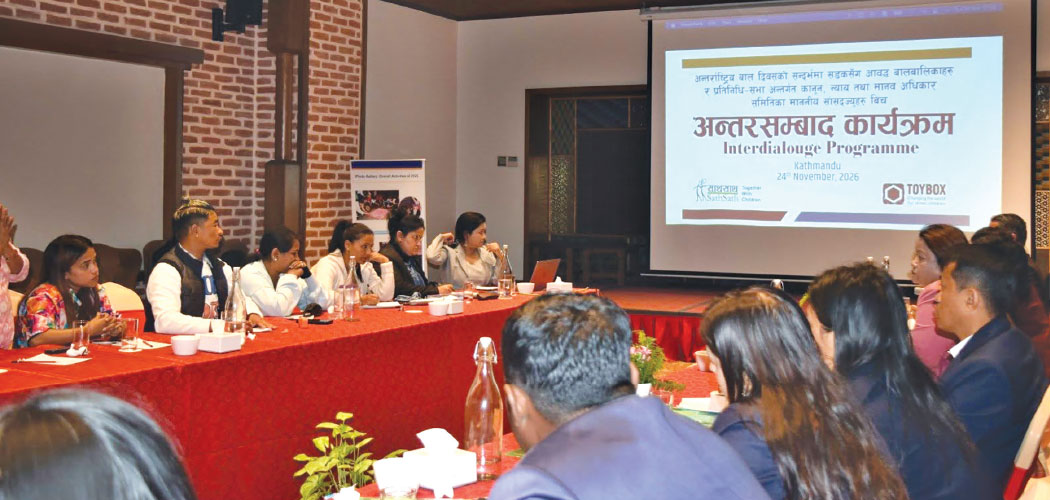
These challenges were highlighted during an interaction programme participated in by children living on the streets and members of the Law, Justice and Human Rights Committee of the House of Representatives. Organised by organised by SathSath, the programme brought together affected individuals and lawmakers to discuss the legal and administrative barriers faced by children without parental care and those lacking legal identity.
The stories of three individuals—Sapana Darji, Kanchhi Gurung and Kailash Rai (name changed)—reflect the difficulties faced by people without legal identity and their struggles to secure a future.
Forty-eight-year-old Sapana has lived in Kathmandu for 33 years. She has only a document confirming her date of birth from her maternal family but no citizenship certificate. Her husband died 20 years ago, leaving her to raise their four children alone. According to her, no one in her husband's family has possessed official documents for three generations. She has been unable to obtain citizenship or register her children's births. Now, schools are demanding birth registration certificates, creating uncertainty about their education and future.
Similarly, Kanchhi, who completed Grade 12, has no legal documents establishing her identity because her father's details and address are unknown. Her husband also lacked identity documents and died nearly a year ago. Their two-year-old son remains without birth registration. Without citizenship, she faces difficulties finding employment and providing financial security for her child.
Another case involves Kailash, who grew up on the streets without knowing his parents or family background. He now works as a Taekwondo instructor at a school and earns additional income through social media platforms. However, without birth registration or citizenship, he cannot open a bank account or obtain a SIM card in his own name. Depending on other people's accounts to receive his earnings has exposed him to financial exploitation.
Kabita Shah, Resource Executive of the SathSath, highlighted the legal and administrative barriers faced by children without parental care, particularly in obtaining birth registration, legal guardianship and banking services.
Shah shared an example of a child whose bank account was approved but could not be operated because the child lacked parents' citizenship documents and a SIM card registered in their own name. She also said she had approached around 15 ward offices in Kathmandu while trying to trace a child's records, but no relevant documentation could be found. She stressed that the lack of birth registration had also forced some children to discontinue their education.
Addressing these concerns, advocate and member of the Law, Justice and Human Rights Committee Madhu Kumar Chaulagain pledged to initiate legal reforms to simplify birth registration, citizenship acquisition and bank account opening for children without parental care.
Chaulagain proposed introducing temporary birth registration for children whose identities are disputed, allowing investigations to continue before converting temporary registration into permanent status. He also emphasised digital birth records at hospitals and border areas, linked with local registration offices.
He further proposed making birth registration mandatory for verified children without parental care and introducing penalties and compensation for officials who fail to fulfil their responsibilities. He also committed to pursuing a directive allowing disadvantaged children to open bank accounts based on recommendations from their respective organisations.
The programme highlighted the urgent need for practical legal reforms and stronger coordination among government agencies to ensure that no child is deprived of identity, education and fundamental rights because of missing parental documents.