




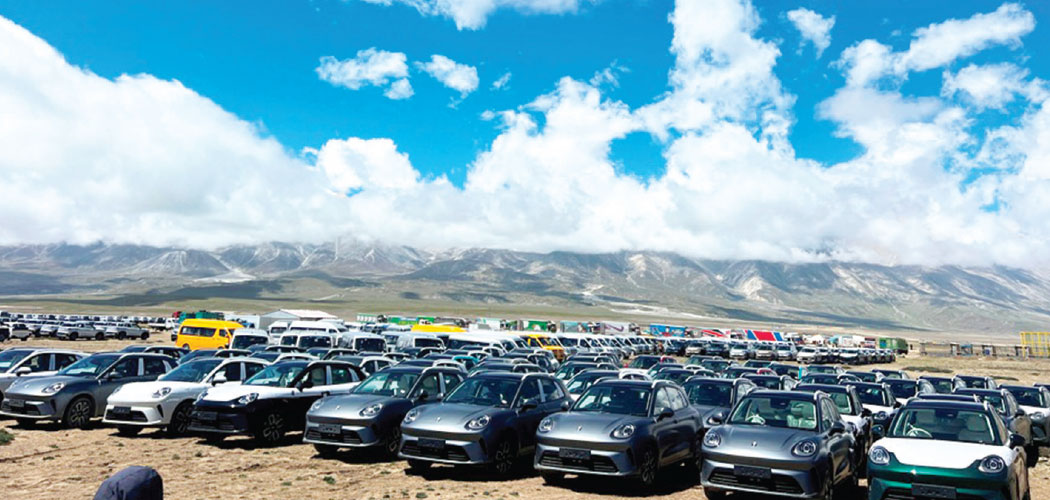
SATV, Kathmandu, Oct. 04 - China has shown interest in developing the Korala border point in Mustang into an international border crossing, with a team including Chinese officials scheduled to arrive from Lhasa to conduct an on-site study.
Korala border point was formally inaugurated amid a ceremony on November 13, 2023. It began commercial operations on September 15, 2025, after which the Chinese side has prioritised the development of settlements and installed modern facilities and technology at the border point.
China has been using the Korala crossing to export Chinese products, including electric vehicles, for trade with Nepal, India and other South Asian countries. It has also shown interest in promoting imports from Nepal, including handicrafts, medicinal herbs and pashmina.
Located at an altitude of 4,650 metres above sea level, the Korala border area has been equipped with basic facilities such as drinking water and toilets, as well as emergency assistance, with the Chinese side seeking to make the crossing a safer route.
China had previously expressed interest in developing Korala as an international border crossing and had made proposals through various channels for the construction of necessary infrastructure. However, the proposals could not be implemented due to inadequate preparations on the Nepali side.
This time, China has formally sent a proposal through the Ministry of Foreign Affairs to Nepal’s Ministry of Physical Infrastructure and Transport, signaling that the process of making the border crossing permanent could gain momentum.
If the Nepal government agrees to China’s proposal for an international border crossing, Korala could become not only a route for the import and export of goods but also a more convenient passage for religious pilgrims and tourists.
According to Bidur Chudal, chief of the Mustang Customs Office, Chinese authorities have shown considerable interest in the Korala border point. “I have received information that they are coming to hold discussions focused on the border point. I have come to Jomsom from Kathmandu, and more details will be known after further discussions,” said Chudal.
Meanwhile, Chief District Officer Ajita Sharma said a team including officials from the Chinese Embassy in Nepal was scheduled to enter Mustang from Tibet through the Lizi-Nechung (Korala) border point on Saturday, via Nepal-China boundary pillar No. 24.
“I have received information that the team includes officials from Nepal’s Ministry of Foreign Affairs. As the mobile network is weak in the upper areas, we have not received further details,” said Sharma.
According to sources, the team will enter from Tibet, travel through Korala to the district headquarters Jomsom and then return. The Chinese and Nepali teams are expected to conduct a study of infrastructure and other facilities at the border point.
At present, Nepal and China use Korala mainly as an alternative and traditional border crossing. Lomanthang Rural Municipality Chairperson Tashi Norbu Gurung said Nepal should take advantage of China’s growing interest in the crossing, particularly as problems have emerged at other border points with China. “This border point is equally important for trade and religious tourism. Chinese interest presents a significant opportunity for Nepal,” said Gurung.
The Korala border point is about 58 kilometres from Zhongba County in China’s Shigatse region, while Lhasa is around 400 kilometres farther from there. Although it is currently not possible to travel from Korala directly to Mount Kailash and Mansarovar, a major pilgrimage destination for Hindus, Buddhists and Jains in China’s Ngari Prefecture, the route through Nepal is considered one of the shortest and most convenient ways to reach the Kailash-Mansarovar region.
Mustang’s representative in the House of Representatives, Yogesh Gauchan Thakali, said Nepal should make the upcoming visit meaningful following China’s renewed interest in developing Korala as an international border crossing.
“The Chinese side is positive about strengthening the physical infrastructure at Korala. We can also seek assistance for roads and other infrastructure,” said Gauchan.
Korala is also considered the shortest route connecting China with India. The 435-kilometre Kaligandaki Corridor, a national pride project, directly links the Chinese border at Korala through Mustang, Myagdi, Baglung, Gulmi, Palpa, Syangja and Nawalparasi to the Indian border at Triveni.
Experts say connecting Korala to trilateral trade among Nepal, China and India, as well as trade with other South Asian countries, could become a significant milestone for Nepal’s economy.