




SATV, Kathmadnu, Mar. 27 - Mithila is a lovely and legendary land, enriched and endowed with many fairs and festivals. There is an uninterrupted and everlasting flow of interrelated festivals throughout the whole year. It has literally become a way of life for the people of Mithila. These fairs and festivals express their joys, pleasures, merriment, and happiness, as well as their displeasures, despairs, disappointments, and dissatisfactions. They also express their fears, hopes, and frustrations, as well as their dreams and sorrows, time and again.
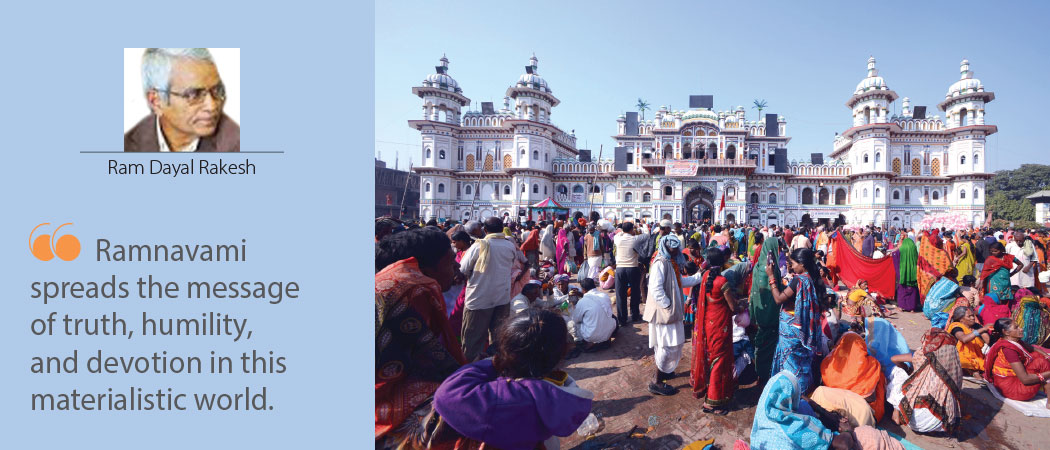
They also mark the colours of the changing seasons; they have become a colourful calendar, providing continuity and meaning for their monotonous and dry lives. They also strengthen the vital bonds between individual members of the community. Ramnavami is one of these festivals, heralding the arrival of the sweetest season of the year. It is still celebrated with immense fanfare every year on the auspicious occasion of the birthday of Lord Ram.
Blessing of Gods
This festival falls on the ninth day of the Chaitra month of the lunar year in ‘Shukla Pakshya’, or the waxing moon, which corresponds to April as per the Gregorian calendar. It is believed that a very famous and benevolent king named Dasharatha ruled the fabulous and wealthy city of Ayodhya in Northern India. Now it falls in the state of U.P. in the Indian Republic. He had three beautiful and dutiful queens, but he had no children. Once, Lord Vishnu appeared before him and asked him to perform a Yagna to please and seek the blessings of the gods.
So, he performed a Yagna. Lord Vishnu, having heard his earnest prayer, gave him a bowl of kheer (rice pudding). There is also another version of this mythology. According to it, the god of fire, Agni, appeared from the Yagna and presented a bowl of kheer to the king, which was distributed among his three queens. After some time, Queen Kaushalya conceived and gave birth to the eldest son, Ram. Then Queen Kaikeyi gave birth to Bharat. After consuming the delicious kheer distributed by the king himself, Sumitra gave birth to the twins, Lakshman and Shatrudhan.
During this festival, ardent devotees observe a fast and perform worship of Lord Ram. They chant the name of Ram and also recite Ramcharitmanas, written by the renowned poet Tulsidas, in the Tarai-Madhesh and Bhanubhakta’s Ramayan in the Kathmandu Valley and the hills. Thus, they remember the very name of God, Ram, all day and night, and pay homage by visiting Ram Mandirs (temples), which are found in almost all villages and towns.
Several prominent poets have penned the life story of Ram in many languages of the world. Valmiki is the first and foremost poet who composed the Valmiki Ramayana in the Sanskrit language. He has described Ram’s whole life story in seven episodes: Balkand (childhood story), Ayodhya Kand (Ayodhya story), Aranya Kand (forest story), Kishkindha Kand, Sundar Kand, Yudha Kand (the story of war), and Uttarkand. The great poet of Nepali literature, Bhanubhakta, has followed the pattern of the great Sanskrit poet Valmiki.
The renowned poet of Hindi literature, Tulsidas, has also written his life story in seven episodes: Balkand, Ayodhya Kand, Aranya Kand, Sundar Kand, Lanka Kand, Uttar Kand, and Lava-Kush Kand. They have all shown their poetic power in describing and highlighting Ram’s life story in their own way.
The great poet of the Maithili language and literature, Chanda Jha, has also composed the life story of Ram in his own way. Now, the popularity of the Ramayana has been spreading in Southeast Asia. Thailand has its own Ramayan in the Thai language. Likewise, every South Asian country has its own Ramayan, and they hold equal respect and reverence for it.
Symbol of humankind
This festival commemorates the birth of Lord Ram, who is widely worshipped in both Nepal and India. He is respected as an ideal symbol of humankind. It is believed that listening to the story of Ram purifies the souls of devotees. Chanting his name is believed to ease the pains and sufferings of the devout.
Ramnavami spreads the message of truth, humility, and devotion in this materialistic world. It also conveys patience, peace, and harmony in human life. It inspires us to follow the spiritual life of Lord Ram, who is the embodiment of righteousness, virtue, and brotherhood. It is not just a celebration of faith in divinity and goodness but also a reminder of Ram’s ideal life and the vision of righteous rule—Ram Rajya.