




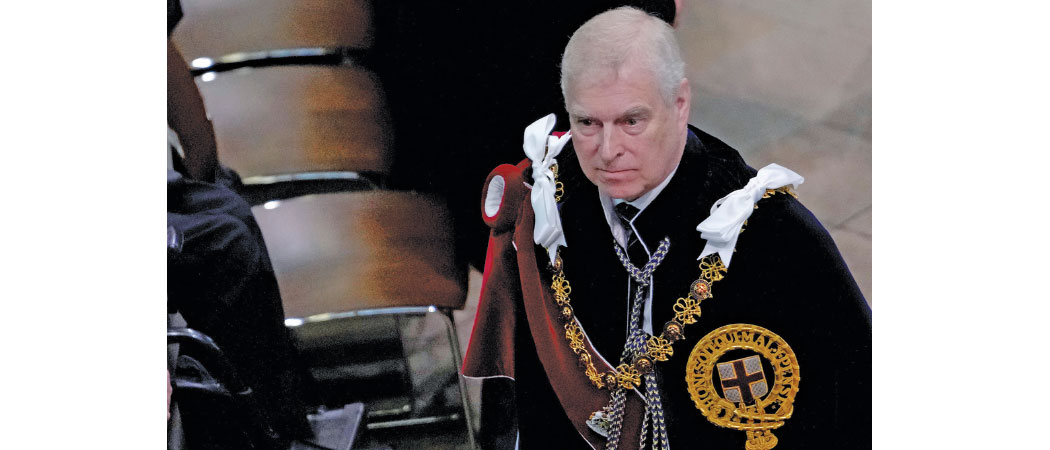
SATV, Kathmandu, Feb.25 - It's been 90 years since a British royal was removed from the line of succession. That might happen again now that Britain's government says it will consider introducing legal changes to formally remove Andrew Mountbatten-Windsor from the list of royals in line to the throne.
Despite being stripped of his status as prince in October over his close links with the late convicted sex offender Jeffrey Epstein, the former Prince Andrew, King Charles III's younger brother, remains eighth in line to become monarch.
Experts say the process of removing him from the line of succession could be lengthy because it requires the involvement of about a dozen countries that also call the British monarch their head of state.
Nonetheless, momentum for change is building after police last week arrested Mountbatten-Windsor on suspicion of misconduct in public office.
Following the release of millions of pages of files last month related to Epstein by the U.S. Justice Department, the former prince was accused of sharing confidential trade information with the disgraced financier when he served as U.K. trade envoy from 2001 to 2011.
Mountbatten-Windsor, 66, was released without charge on Thursday after spending about 11 hours in custody, but he remains under investigation.
"The government is clear that we are not ruling out action in respect of the line of succession at this stage, and we will consider whether any further steps are required in due course," Darren Jones, Prime Minister Keir Starmer's chief secretary, told lawmakers on Monday.
Any such measure will only take place once the police investigation is finished, he added.
Under the current line of royal succession, Charles' son Prince William is heir to the throne and his three children — Prince George, Princess Charlotte and Prince Louis — are next. Prince Harry is fifth, while his two children, Prince Archie and Princess Lilibet, are sixth and seventh in line.
Mountbatten-Windsor — who was second in line to the throne at his birth — currently follows them in eighth position. His daughters, Princesses Beatrice and Eugenie, are at ninth and 12th places respectively.
Removing him from the line of succession would require an act of Parliament, which needs lawmakers' approval. One party, the Liberal Democrats, has been vocal about supporting such a move.
Any change to the line of succession would also require backing from 14 Commonwealth countries where Charles is head of state.
Of those, Australia and New Zealand have said they would support any U.K. government plan to exclude Mountbatten-Windsor.
"These are grave allegations and Australians take them seriously," Australia's Prime Minister Anthony Albanese wrote in a letter to Starmer. "I agree with His Majesty that the law must now take its full course and there must be a full, fair and proper investigation."
Starmer's government is not believed to have received similar letters from other countries that also have Charles as head of state, including Canada, Jamaica, the Bahamas and Tuvalu.
Robert Hazell, a politics professor who founded the Constitution Unit at University College London, said in some countries the change will require a formal constitutional amendment, while in others it can be done by legislation.
He expressed doubt that the U.K. or the other governments would want to spend time removing Mountbatten-Windsor from the succession line given he is only eighth in line.
"The last time this happened was for the Succession to the Crown Act 2013, which made the law of royal succession gender neutral," he said. "It took two years of protracted negotiations for all the different countries to amend their own laws or constitutions."(AP)